

THE CENTRAL IDEA · OUR READING
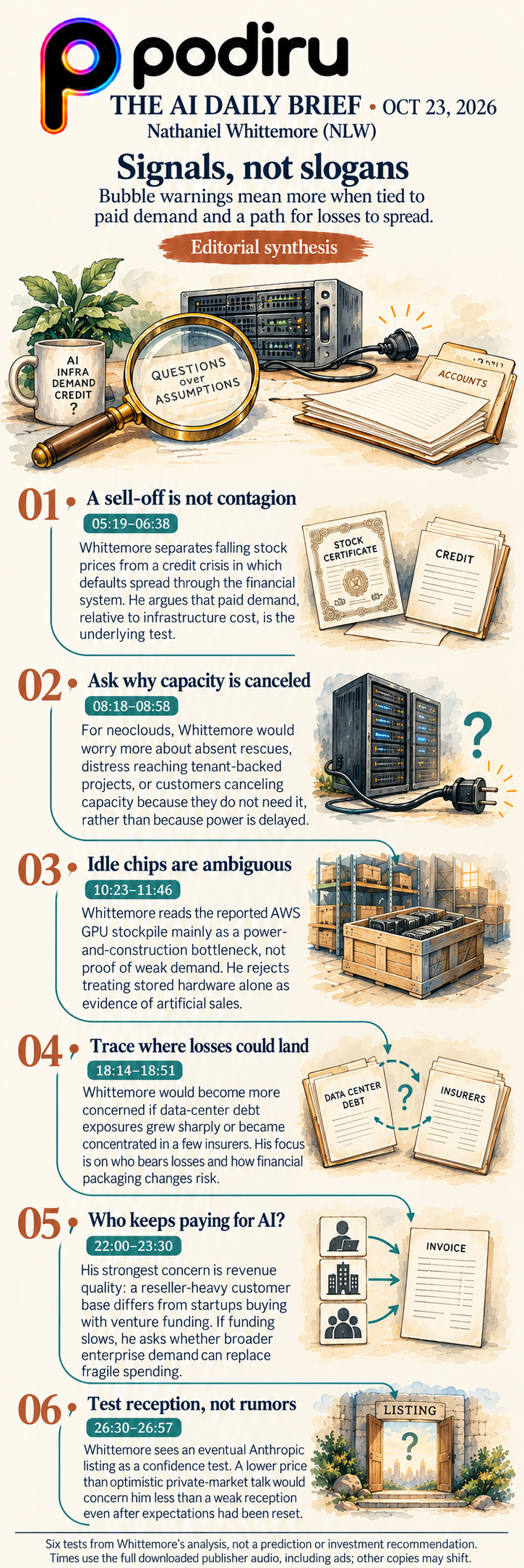
Bubble warnings mean more when tied to paid demand and a path for losses to spread.
- 01
A sell-off is not contagion
Whittemore separates falling stock prices from a credit crisis in which defaults spread through the financial system. He argues that paid demand, relative to infrastructure cost, is the underlying test.
Why it matters · our reading Different failure mechanisms require different evidence. A painful valuation reset does not by itself establish widespread inability to repay debt.
Keep in mind: This distinction does not make a sell-off harmless, nor prove that credit losses cannot spread. The episode is a framework for uncertainty, not a forecast of safety.
Source passage: 05:19–06:38
- 02
Ask why capacity is canceled
For neoclouds, Whittemore would worry more about absent rescues, distress reaching tenant-backed projects, or customers canceling capacity because they do not need it, rather than because power is delayed.
Why it matters · our reading A construction bottleneck and a loss of paying demand can produce similar headlines but imply different risks for the business model.
Keep in mind: These are his proposed warning signs, not confirmed new failures. Support from larger firms is not a guarantee that smaller providers or their creditors will be protected.
Source passage: 08:18–08:58
- 03
Idle chips are ambiguous
Whittemore reads the reported AWS GPU stockpile mainly as a power-and-construction bottleneck, not proof of weak demand. He rejects treating stored hardware alone as evidence of artificial sales.
Why it matters · our reading Hardware cannot earn revenue until a site is ready. The cause and duration of that delay matter more than a photograph or headline about unused chips.
Keep in mind: This is his interpretation of reporting, not an audit of Amazon or Nvidia. A power constraint does not establish profitable future demand or eliminate financing risk.
Source passage: 10:23–11:46
- 04
Trace where losses could land
Whittemore would become more concerned if data-center debt exposures grew sharply or became concentrated in a few insurers. His focus is on who bears losses and how financial packaging changes risk.
Why it matters · our reading Systemic risk depends on concentration, leverage and connections between institutions, not simply on whether an AI-related bond exists in a portfolio.
Keep in mind: The episode does not establish the full exposure of insurers or pensions. Its reassurance is not proof of safety; neither these sources nor the ASR can determine who would bear every loss.
Source passage: 18:14–18:51
- 05
Who keeps paying for AI?
His strongest concern is revenue quality: a reseller-heavy customer base differs from startups buying with venture funding. If funding slows, he asks whether broader enterprise demand can replace fragile spending.
Why it matters · our reading Concentrated revenue can be especially vulnerable when the largest users can lose their funding or stop buying. Rising use across more firms would test whether adoption is broadening.
Keep in mind: Ramp’s customer sample is not the whole economy. The host’s interpretation cannot establish that all startup demand is subsidized or that hyperscaler resale contracts are secure.
Source passage: 22:00–23:30
- 06
Test reception, not rumors
Whittemore sees an eventual Anthropic listing as a confidence test. A lower price than optimistic private-market talk would concern him less than a weak reception even after expectations had been reset.
Why it matters · our reading Public disclosure and real investor demand could make revenue quality and valuation disagreements easier to assess than selective private-market reports.
Keep in mind: This is a conditional scenario, not a confirmed IPO date, valuation or prediction of contagion. Anthropic’s official filing notice says an offering remains subject to market conditions.
Source passage: 26:30–26:57
How the ideas connect
Separating failure mechanisms leads to asking why capacity is canceled. Both distinguish missing demand from a bottleneck preventing delivery. A credit-crisis thesis requires evidence of exposure and transmission. Installed capacity is not the same as sustainable paying use. Public reporting could test claims about customer durability and growth.
Full-episode overview
Nathaniel Whittemore opens by ranking AI-bubble warnings rather than trying to prove either an inevitable crash or universal safety. He reviews a market sell-off and competing views from financial executives, emphasizing that those speakers may have commercial interests. He treats demand for valuable, paid AI use relative to infrastructure costs as the underlying question. His distinction between a stock-market correction and a credit crisis is central: investor losses and system-wide repayment problems are related possibilities, not interchangeable descriptions.
The episode discusses Gartner’s pessimistic infrastructure forecast, then neocloud funding problems, reported rescue efforts and the importance of why customers abandon capacity. The accompanying primary-source check changes an important wording detail: Gartner forecasts that more than 80% of neocloud providers will cease independent operations by 2030, not that all of those firms will go bankrupt. Its potential impairment estimate is conditional exposure under stated spending and return assumptions, not realized losses. Whittemore’s broad claim that the neocloud sector could disappear with little direct economic impact is not adopted as an independently established conclusion.
A reported AWS stockpile becomes a test of competing explanations. The host relays Amazon’s routine-staging explanation and critics’ allegation of artificial sales, then favors a shortage of powered data centers over a shortage of eventual customers. That is an interpretation, not a forensic accounting finding. Power delays, financing costs and uncertainty about ultimate demand can coexist.
The credit discussion asks where losses might travel through insurers, private equity and pensions. Whittemore acknowledges incomplete visibility, but offers reassurance based on reported positions and differences from the subprime crisis. This brief retains his questions about scale, concentration and packaging without endorsing a complete exposure estimate, the assertion that annuity risk mainly affects wealthy people, or a blanket claim that today’s debt cannot hide risk. The sponsor break was reviewed separately from the editorial argument.
On public equity gifts and potential bailouts, Whittemore considers the political incentives of very large firms but does not accept that the gifts prove a deliberately engineered rescue. He treats future requests for explicit federal guarantees as a more concrete signal to watch. His descriptions of executives’ motives are opinion, not established intent.
Revenue quality is his strongest concern. He distinguishes concentration caused by a reseller relationship from dependence on venture-funded startups, acknowledges the narrowness of Ramp’s customer sample, and asks whether spending will broaden as firms mature. He sees a future Anthropic IPO as a possible confidence test and source of fuller public disclosure, while distinguishing accounting losses from cash consumption and rumors from completed financing terms. The brief does not present leaked valuations or an anticipated listing date as confirmed. It also avoids the episode’s inaccurate shorthand that all quarterly financial statements are fully audited. He closes by noting that previous premature bubble warnings do not prove future warnings wrong, and that the outlook remains uncertain.
Primary-source context: Ramp supports the existence of concentrated spending within its observed businesses and warns that its small top-spender group is volatile and subject to revised estimates. The separate claim about the proportion of top spenders that are venture-backed was not independently established and is omitted. IMF and FSB analyses support concern about interconnected, illiquid financial exposures and limited data, not a precise AI-specific loss bound or a guarantee about whose savings are exposed.
Sources & the fine print
Complete machine-transcript review of the downloaded publisher audio, with targeted retranscription of flagged spans. Not a claimed manual end-to-end audio listen. Interpretations and material caveats are labeled; display times round outward and may shift in differently ad-inserted copies.
Full publisher-audio ASR reviewed end to end, with targeted rechecks. Original paraphrase; no transcript redistribution. This is an editorial episode summary, not financial advice.
- Publisher episode and full downloaded audio
- Publisher feed
- Publisher companion newsletter, used for corroboration rather than as a substitute for audio
- Gartner’s conditional infrastructure forecast and precise neocloud wording
- Anthropic’s confidential filing notice and offering contingencies
- Ramp October AI Index: concentration within its observed firms, with volatility and revisions caveats
- IMF: financial-risk channels, not an AI-only exposure estimate
- FSB: private-credit interconnections and data gaps, not all private credit is AI lending
- Six tests from Whittemore’s analysis, not a prediction or investment recommendation. Times use the full downloaded publisher audio, including ads; other copies may shift.
Chart-informed editorial collection using Apple Podcasts trending episode charts, retrieved October 24, 2026. Not verified annual episode-level listening totals.