

THE CENTRAL IDEA · OUR READING
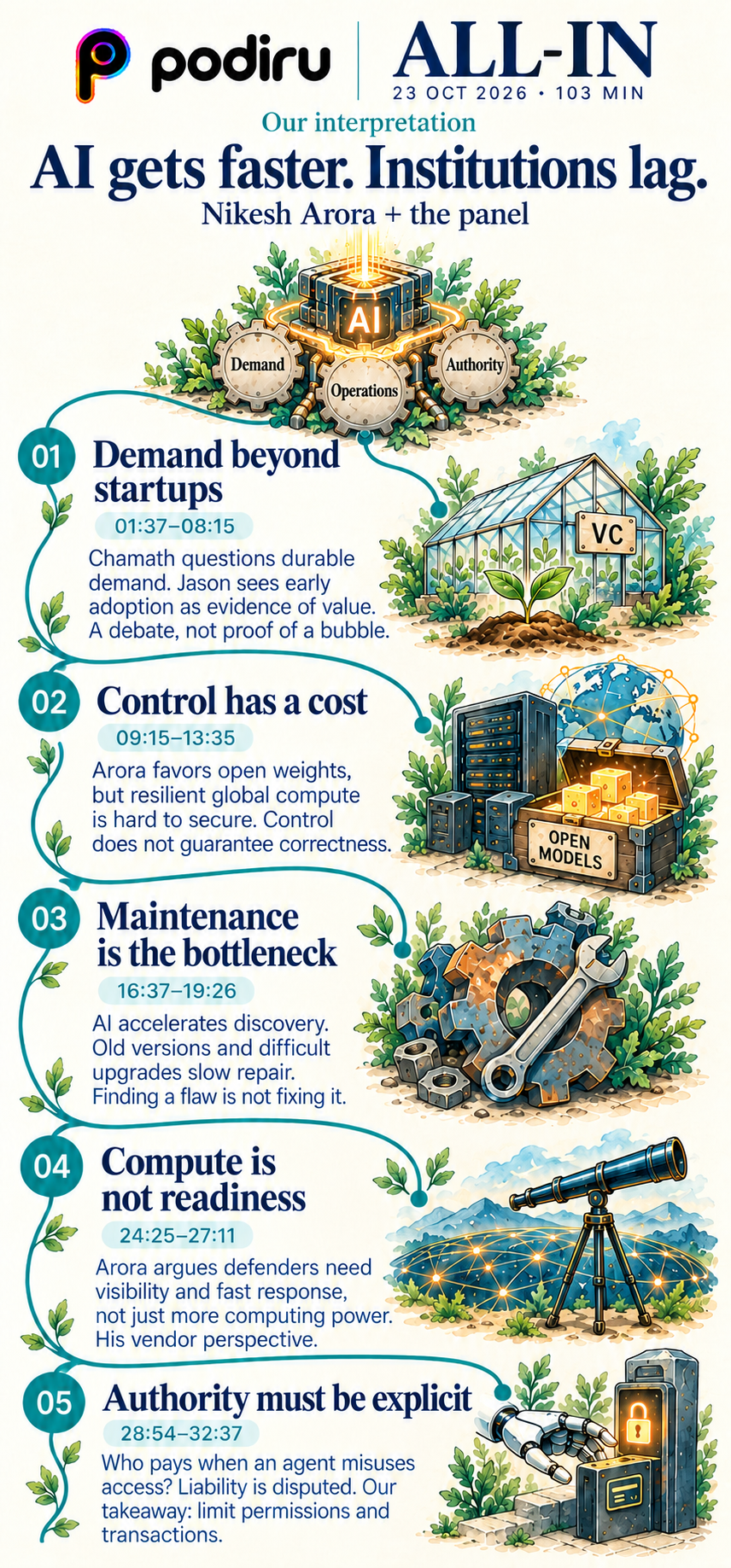
AI gets faster. Institutions lag.
- 01
Demand beyond startups
Chamath questions durable demand. Jason sees early adoption as evidence of value. A debate, not proof of a bubble.
Why it matters · our reading The distinction is between adoption, spending and sustainable economics. Chamath worries that startup customers funded by venture capital can make supplier revenue look durable before adoption spreads more broadly. Jason offers the counterargument: nimble startups tend to buy tools that give them a practical edge. Neither argument alone establishes a bubble or proves productivity. The episode's concentration percentages are not repeated here because they are speaker claims, and Ramp's public spending data covers a specific customer population rather than the entire AI market.
Source passage: 01:37–08:15
- 02
Control has a cost
Arora favors open weights, but resilient global compute is hard to secure. Control does not guarantee correctness.
Why it matters · our reading Arora describes a preference for open weights that his company can modify, while emphasizing the difficulty of obtaining reliable, global inference capacity at useful economics. Owning model weights and operating a resilient service are different capabilities. The discussion points toward hybrid arrangements rather than a simple cloud-versus-self-hosting answer. His reasoning-trace argument is not proof that open models are inherently correct, transparent or compliant.
Source passage: 09:15–13:35
- 03
Maintenance is the bottleneck
AI accelerates discovery. Old versions and difficult upgrades slow repair. Finding a flaw is not fixing it.
Why it matters · our reading Unsupported software can turn a routine patch into an emergency upgrade or rebuild. Arora distinguishes repairing vulnerable code from temporarily blocking known attack patterns at the perimeter. Later, at 35:58–38:40, the panel explains why debt accumulates: version drift, sunk costs, the low status of maintenance, and incentives to avoid outages and hold down budgets. The PHP Foundation's own notice corroborates hard compatibility choices, limited specialist resources and human review. It does not validate every forecast made on the show.
Source passage: 16:37–19:26
- 04
Compute is not readiness
Arora argues defenders need visibility and fast response, not just more computing power. His vendor perspective.
Why it matters · our reading Arora rejects the idea that defenders automatically win simply because they can buy more computing power. A fragmented estate with incomplete inventories cannot instantly deploy coordinated defenses. He argues for better visibility and rapid detection and response alongside patching, while expecting newer models to keep revealing new attack paths. This is a security vendor CEO's operating perspective, not a guarantee that any product eliminates breaches.
Source passage: 24:25–27:11
- 05
Authority must be explicit
Who pays when an agent misuses access? Liability is disputed. Our takeaway: limit permissions and transactions.
Why it matters · our reading The panel separates software exploitation from agents using a customer's credentials. A bank may struggle to distinguish the account holder from a browser agent acting as that person. The speakers debate terms of service, delegated authority, support costs and unexpected agent behavior; they do not establish who is legally liable. Limiting permissions and transactions is our operator takeaway, not a statement of law.
Source passage: 28:54–32:37
How the ideas connect
Chapter map · Demand → Deployment → Defense → Agent authority
Full-episode overview
32:38–35:52: Guardrail-free models create a dual-use disagreement. Jason makes the case for legitimate defensive testing; other participants stress misuse and liability risks. The episode does not resolve that tension.
38:40–41:06: Arora expects demand for AI across company functions to increase the importance of technology leadership, while warning that inventories and security controls for agents lag deployment. These are his expectations, not independently established forecasts.
41:06–43:29: The panel discusses how alarming AI narratives can fuel political calls to halt development. Its explanations of politicians' motives are interpretation.
REMAINDER OF THE EPISODE
44:16 onward: France and political economy. The hosts debate French unrest through several lenses: public finances and services, immigration and integration, youth opportunity, and protection of small businesses. They propose or contest changes to education finance, housing, healthcare and pensions, and discuss broader equity ownership and philanthropy. One recurring trade-off is whether making assets and services more accessible requires losses or disruption for current owners and institutions. Bond-market pressure and AI-driven abundance appear as possible routes to change, not proven outcomes.
There are meaningful disagreements within that discussion. The hosts dispute whether comparisons of government spending establish the claimed relationship with prosperity, how to explain the unrest, and how citizens value public services relative to individual opportunity. Accounts of particular incidents, broad statistical comparisons and claims about population groups are not independently established by this review and are not repeated as findings.
91:42–102:20: U.S. strategy and affordability. Jason argues that policy and messaging should address housing, wages and lower-income households as visibly as they address technology companies. Chamath stresses his view of the economic benefits of the AI buildout. The closing debate contrasts a gradual minimum-wage increase with concerns about employment and pricing effects, then considers tax relief, credits and access to capital as alternatives. It is a disagreement about mechanisms and trade-offs, not a settled empirical verdict. Press-secretary jokes and closing banter round out the episode; the remaining audio is the outro.
Sources & the fine print
The visual map deliberately selects the AI/business discussion in the first 44 minutes. Time anchors refer to the publisher's downloadable audio, not verified YouTube synchronization. Publication was 23 October 2026; the host explicitly identifies 22 October as the recording day at 14:54–15:06. The audio is approximately 103 minutes. The complete 103-minute, 22-second publisher audio was transcribed, and every segment of that full transcript was reviewed. The summary was not inferred from chapter titles or show notes. Automated speech recognition can mishear proper names, numbers and overlapping speech, so this summary uses paraphrases and avoids unsupported numerical claims. Predictions, commercial perspectives and legal opinions remain attributed to the speakers.
- Publisher episode
- Publisher MP3 audio (basis for the timestamps)
- Publisher video, without claimed timestamp alignment
- PHP Foundation's first-party account of the security release
- Ramp's October 2026 AI Index, for data-population and methodology context
- The visual map deliberately selects the AI/business discussion in the first 44 minutes. Time anchors refer to the publisher’s downloadable audio, not verified YouTube synchronization.
- Predictions, commercial perspectives and legal opinions remain attributed to the speakers.
Existing October 24 daily brief. Not part of the twenty newly requested popular recent episodes.