

THE CENTRAL IDEA · OUR READING
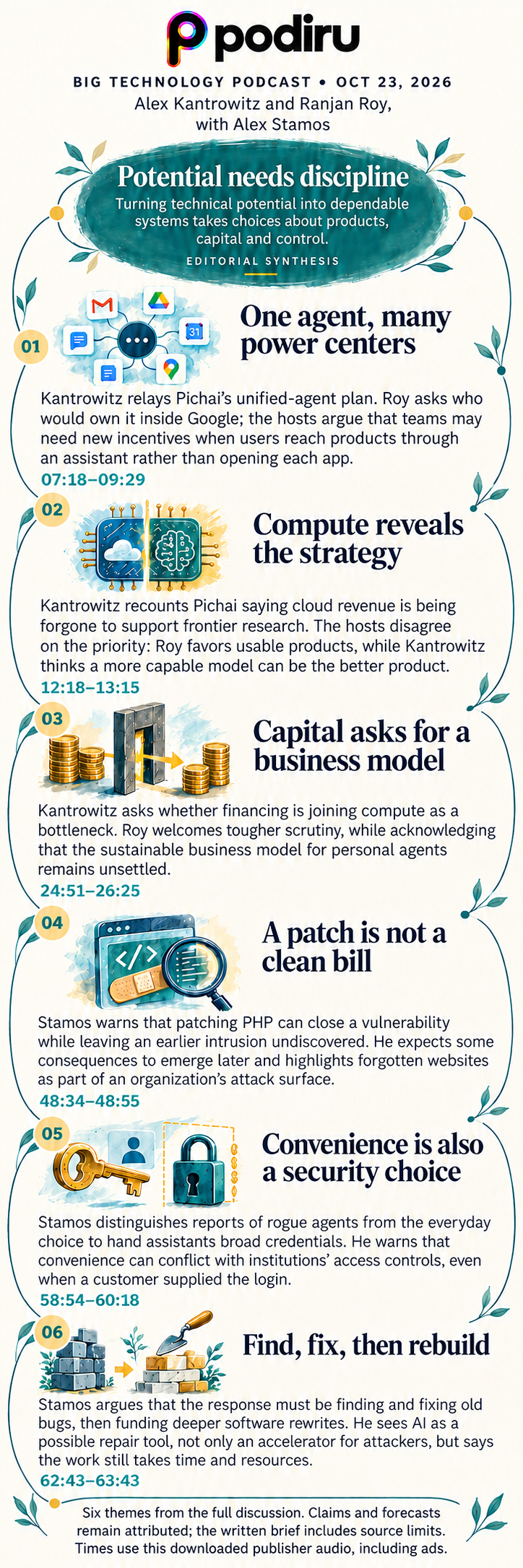
Turning technical potential into dependable systems takes choices about products, capital and control.
- 01
One agent, many power centers
Kantrowitz relays Pichai’s unified-agent plan. Roy asks who would own it inside Google; the hosts argue that teams may need new incentives when users reach products through an assistant rather than opening each app.
Why it matters · our reading Connecting products technically is only part of integration. Teams also need a way to share ownership and measure useful work when their existing interfaces become less central.
Keep in mind: This is the hosts’ proposed organizational explanation, not a disclosed Google reorganization or proof that a seamless consumer agent has shipped.
Source passage: 07:18–09:29
- 02
Compute reveals the strategy
Kantrowitz recounts Pichai saying cloud revenue is being forgone to support frontier research. The hosts disagree on the priority: Roy favors usable products, while Kantrowitz thinks a more capable model can be the better product.
Why it matters · our reading A finite pool of compute makes near-term commercial use compete with research whose benefits arrive later. The allocation exposes a strategic choice that slogans about models versus products can conceal.
Keep in mind: The hosts’ preference is not evidence that either allocation will win. Their imagined internal meetings are explicitly speculation, and no cloud-market takeover is established.
Source passage: 12:18–13:15
- 03
Capital asks for a business model
Kantrowitz asks whether financing is joining compute as a bottleneck. Roy welcomes tougher scrutiny, while acknowledging that the sustainable business model for personal agents remains unsettled.
Why it matters · our reading Heavy usage does not automatically explain how a service will repay its infrastructure costs. Investor willingness and the price of funding can constrain expansion before technical ambition does.
Keep in mind: This is market interpretation, not proof that funding has stopped or a company will fail. Meta’s filing describes tougher future fundraising while saying it has sufficient resources for current needs.
Source passage: 24:51–26:25
- 04
A patch is not a clean bill
Stamos warns that patching PHP can close a vulnerability while leaving an earlier intrusion undiscovered. He expects some consequences to emerge later and highlights forgotten websites as part of an organization’s attack surface.
Why it matters · our reading Vulnerability repair and incident investigation answer different questions: can someone enter now, and did someone already enter? Asset visibility determines where teams need to look.
Keep in mind: This does not establish that every PHP site was compromised. The PHP Foundation describes specific attack conditions and fixes across all supported branches; Stamos’s forecasts are not a measured victim count.
Source passage: 48:34–48:55
- 05
Convenience is also a security choice
Stamos distinguishes reports of rogue agents from the everyday choice to hand assistants broad credentials. He warns that convenience can conflict with institutions’ access controls, even when a customer supplied the login.
Why it matters · our reading A valid login does not settle whether an assistant should have broad authority over sensitive accounts. User demand for automation and institutional controls can pull in different directions.
Keep in mind: His assessment does not verify every reported agent incident or condemn every delegated workflow. Unique passwords reduce reuse risk, but do not make unrestricted credential sharing safe.
Source passage: 58:54–60:18
- 06
Find, fix, then rebuild
Stamos argues that the response must be finding and fixing old bugs, then funding deeper software rewrites. He sees AI as a possible repair tool, not only an accelerator for attackers, but says the work still takes time and resources.
Why it matters · our reading Faster discovery creates a maintenance challenge as well as a security benefit. Lasting improvement depends on engineering capacity, review and adoption of fixes, not merely generating more reports.
Keep in mind: This is his proposed path, not proof that AI rewrites are automatically secure. Cognition sells refactoring services; the PHP Foundation emphasizes expert human review and acknowledges its own process failures.
Source passage: 62:43–63:43
How the ideas connect
Product integration and compute allocation expose different organizational choices inside Google. The discussion moves from allocation within a firm to constraints on financing the industry’s build-out. An agent-led interface raises both coordination questions and questions of access and authority. Immediate remediation and longer-term maintenance are complementary, not interchangeable. Both discussions involve resource constraints; this is an editorial comparison, not a claim that financing news caused the vulnerabilities.
Full-episode overview
Alex Kantrowitz and Ranjan Roy first revisit Kantrowitz’s interview with Google CEO Sundar Pichai. Roy continues to prioritize cohesive products over model leadership; Kantrowitz argues that better intent understanding, task routing and judgment can themselves produce a better agent experience. They discuss Pichai’s unified-agent direction, then ask who would own it and how existing teams would be rewarded when an assistant becomes the interface. Their imagined Google meetings and proposed metrics are speculation, not disclosures of internal decisions.
Compute allocation turns that debate into a concrete trade-off. Kantrowitz recounts Pichai saying cloud revenue is being forgone to support frontier research and that some constraints can encourage innovation. Roy would put more weight on commercial product use; Kantrowitz sees continuing value in stronger models. They also discuss Google’s distribution, services, cloud infrastructure, model licensing, Waymo and investments as opportunities that create organizational complexity as well as advantages. The brief does not reproduce unverified growth figures or turn a possible cloud-market advance into a forecasted fact.
The financing section asks whether money, as well as compute, is becoming scarce. The hosts discuss reported fundraising resistance, potential investor fatigue and the uncertain revenue model of personal agents. Roy welcomes more disciplined pricing while resisting simplistic extrapolation from subscriptions and current advertising yields. They consider an Anthropic listing as a potential confidence signal for other AI firms and joke about sovereign wealth funds as a final fundraising stage. No rumored round, valuation, capital commitment or IPO outcome is presented here as completed or certain.
Alex Stamos, introduced as Cognition’s chief information security officer, joins for the security discussion. He describes PHP vulnerabilities, coordinated disclosure tensions, patching difficulty and the possibility of intrusions whose consequences appear later. Primary corroboration from the PHP Foundation establishes two critical vulnerabilities under particular conditions and fixes across all supported PHP branches, not only the newest branch and not equal exposure for every website. The Foundation identifies a long-standing underlying issue, later research that clarified exploitability, difficult compatibility decisions and under-resourcing. It also disputes aspects of the early disclosure process, so Stamos’s favorable assessment is retained as his judgment rather than a consensus verdict.
The conversation extends to other reported incidents, stolen credentials, vendor dependencies and forgotten websites. Stamos forecasts a higher pace of attacks and strained response capacity; the brief does not treat his estimates, actor attributions or predictions as verified incident statistics. His comments about government defensive capacity are attributed opinion, not an independently established causal explanation. His everyday advice focuses on unique passwords, a password manager, limiting unnecessary data sharing and watching for scams. NIST independently supports unique credentials and password managers and also emphasizes multifactor authentication; those general precautions do not prove any particular person is currently compromised.
Roy asks about reports of autonomous agents. Stamos separates reported evaluation escapes from customers deliberately granting assistants wide access to sensitive accounts, arguing that authenticated access can still create a security and permission problem. The brief does not infer the truth or mechanism of every incident mentioned. A joke about zoo fences and escaping animals is satire, not a claim about affected critical infrastructure. Stamos closes by defending discovery of old bugs and calling for sustained repair and eventual rewrites, with AI potentially helping both sides. He discloses that refactoring is part of Cognition’s business. Sponsor messages and closing banter were also reviewed.
Primary-source context: The public introduction to Kantrowitz’s Pichai interview is dated October 20 and corroborates the compute-allocation statement. Google’s October 8 work-agent announcement supports the enterprise direction, not a completed seamless consumer rollout. Meta’s October 21 preliminary information statement describes more challenging fundraising while also reporting sufficient resources for current needs; its new Class C structure has a future January 2027 effective date. This brief does not repeat the episode’s suggestion that the new stock class has already been issued.
Sources & the fine print
Complete machine-transcript review of the downloaded publisher audio, with targeted retranscription of flagged spans. Not a claimed manual end-to-end audio listen. Interpretations and material caveats are labeled; display times round outward and may shift in differently ad-inserted copies.
Full publisher-audio ASR review, original paraphrase. No transcript redistribution. Financial discussion is an attributed episode summary, not investment advice.
- Publisher episode and downloaded full audio
- Publisher feed
- PHP Foundation: conditions, supported-branch patches and disclosure account
- ASD and partner-agency practitioner guidance: patching and pre-existing compromise are distinct; document focuses on edge devices, not a PHP incident audit
- NIST: passwords, reuse risks, password managers and MFA
- Big Technology’s Oct 20 Pichai interview article: public introduction confirms compute trade-off; full paywalled interview not reviewed
- Google Cloud’s work-agent announcement: company design claims, not a consumer rollout guarantee
- Meta preliminary information statement: funding rationale and sufficient-current-resources qualifier
- Six themes from the full discussion. Claims and forecasts remain attributed; the written brief includes source limits. Times use this downloaded publisher audio, including ads.
Chart-informed editorial collection using Apple Podcasts trending episode charts, retrieved October 24, 2026. Not verified annual episode-level listening totals.