

THE CENTRAL IDEA · OUR READING
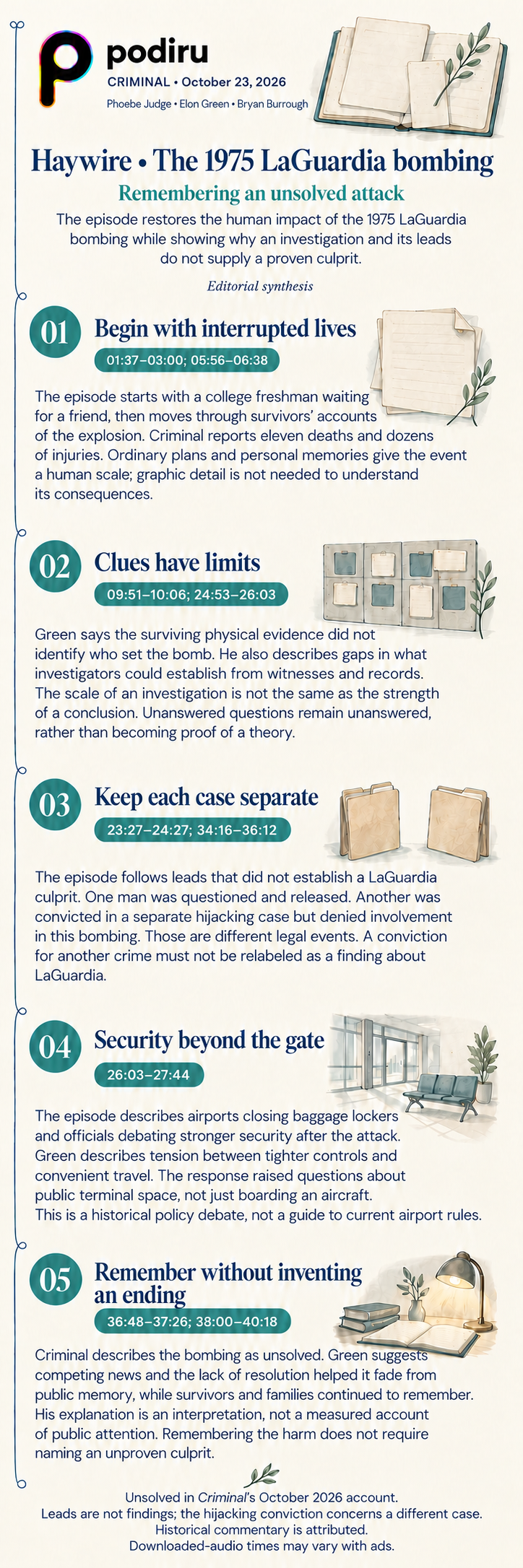
The episode restores the human impact of the 1975 LaGuardia bombing while showing why an investigation and its leads do not supply a proven culprit.
- 01
Begin with interrupted lives
The episode starts with a college freshman waiting for a friend, then moves through survivors’ accounts of the explosion. Criminal reports eleven deaths and dozens of injuries. Ordinary plans and personal memories give the event a human scale; graphic detail is not needed to understand its consequences.
Why it matters · our reading An investigation concerns people whose lives were interrupted, not just an intriguing unresolved puzzle.
Keep in mind: The publisher reports 75 injuries; early archival counts vary. The brief uses dozens rather than implying the provisional reports all agree. Survivor accounts are not independently reconstructed here.
Source passage: 01:37–03:00; 05:56–06:38
- 02
Clues have limits
Green says the surviving physical evidence did not identify who set the bomb. He also describes gaps in what investigators could establish from witnesses and records. The scale of an investigation is not the same as the strength of a conclusion. Unanswered questions remain unanswered, rather than becoming proof of a theory.
Why it matters · our reading Separate the effort invested in an investigation from the evidentiary support for its result.
Keep in mind: January 1976 government correspondence corroborates an early lack of solid leads, not the whole later investigation. No current law-enforcement case file was independently examined.
Source passage: 09:51–10:06; 24:53–26:03
- 03
Keep each case separate
The episode follows leads that did not establish a LaGuardia culprit. One man was questioned and released. Another was convicted in a separate hijacking case but denied involvement in this bombing. Those are different legal events. A conviction for another crime must not be relabeled as a finding about LaGuardia.
Why it matters · our reading Attach a legal outcome to the specific conduct and case it actually resolves, rather than letting proximity suggest guilt.
Keep in mind: Walter Long was released after questioning. Zvonko Busic’s affirmed convictions concerned the September 1976 TWA hijacking and the related Grand Central bomb, not the December 1975 LaGuardia bombing. His denial and the absence of a LaGuardia finding are retained.
Source passage: 23:27–24:27; 34:16–36:12
- 04
Security beyond the gate
The episode describes airports closing baggage lockers and officials debating stronger security after the attack. Green describes tension between tighter controls and convenient travel. The response raised questions about public terminal space, not just boarding an aircraft. This is a historical policy debate, not a guide to current airport rules.
Why it matters · our reading A policy response can extend beyond the immediate site of an incident and still involve legal, economic and operational tradeoffs.
Keep in mind: The January 1976 federal documents corroborate the security review and proposed measures. Proposed, planned and implemented changes are not interchangeable; the brief does not claim every proposal became policy.
Source passage: 26:03–27:44
- 05
Remember without inventing an ending
Criminal describes the bombing as unsolved. Green suggests competing news and the lack of resolution helped it fade from public memory, while survivors and families continued to remember. His explanation is an interpretation, not a measured account of public attention. Remembering the harm does not require naming an unproven culprit.
Why it matters · our reading The absence of a solved-case ending does not make the human consequences unworthy of attention.
Keep in mind: Current unresolved status is attributed to the publisher’s October 2026 account, not a newly obtained official case-status statement. The guests’ broad claim that no one ever advocated for the case is not repeated.
Source passage: 36:48–37:26; 38:00–40:18
How the ideas connect
The opening restores the lives behind the case. The evidence chapter establishes limits, while the separate-leads chapter shows why suspicion and another conviction do not supply the missing answer. The security chapter follows a documented public-policy response without confusing it with a solved investigation. The final chapter returns from institutions and suspects to memory. This is an editorial reading of the episode, not an independent identification of a perpetrator or motive.
Full-episode overview
Phoebe Judge’s Haywire begins with a young visitor arriving at LaGuardia and survivors describing the December 29, 1975 explosion. Criminal reports eleven deaths and 75 injuries; this brief uses dozens of injuries because early contemporaneous counts differ. The narrative presents the emergency response, false leads, and the difficulty of identifying a perpetrator from the available observations and surviving physical evidence. The full source, including every advertisement, promo and credit, was reviewed through its machine transcript. Graphic injury descriptions and operational explosive details are excluded.
The episode places the attack in a period of frequent political bombings. Bryan Burrough gives his interpretation of why some groups used the tactic, why many incidents faded from memory, and why those tactics later declined. These are attributed historical explanations, not a general statistical demonstration. The episode explicitly says there was no evidence connecting the FALN to the LaGuardia bombing and retains the PLO’s denial of an unvalidated responsibility claim. It does not establish any organization as the culprit.
A man sought for questioning, Walter Long, denies involvement and is released. The program then describes security debates after the attack and turns to the September 1976 TWA hijacking led by Zvonko Busic. A related Grand Central bomb killed police officer Brian Murray. Busic’s convictions were for aircraft piracy, conspiracy and aircraft piracy resulting in death, as the subsequent appellate opinion confirms; they were not convictions for the 1975 LaGuardia bombing. He denied involvement in that earlier attack. The brief does not reproduce operational details, treat alleged coincidence as proof, or imply that questioning amounted to a LaGuardia charge or conviction.
Criminal’s October 2026 account says the LaGuardia bombing remains unsolved. Elon Green describes uncertainty about both perpetrator and motive, then offers an explanation for why the story receded from public awareness. The memories of survivors and victims’ families contrast with that wider forgetting. His ideas about competing headlines, the difficulty of writing unresolved stories and the role of external pressure are interpretations, not proof that nobody cared or that a particular agency deliberately suppressed the case. The final credits identify Green’s Slate article and the episode’s production team.
Sources & the fine print
Complete machine-transcript review of the downloaded publisher audio, with targeted retranscription of flagged spans. Not a claimed manual end-to-end audio listen. Interpretations and material caveats are labeled; display times round outward and may shift in differently ad-inserted copies.
- Criminal: Haywire, episode 386
- Gerald R. Ford Presidential Library: LaGuardia bombing correspondence
- Gerald Ford statement, December 29, 1975
- United States v. Busic, 592 F.2d 13 (Second Circuit, 1978)
- Unsolved in Criminal’s October 2026 account. Leads are not findings; the hijacking conviction concerns a different case. Historical commentary is attributed. Downloaded-audio times may vary with ads.
Chart-informed editorial collection using Apple Podcasts trending episode charts, retrieved October 24, 2026. Not verified annual episode-level listening totals.