

THE CENTRAL IDEA · OUR READING
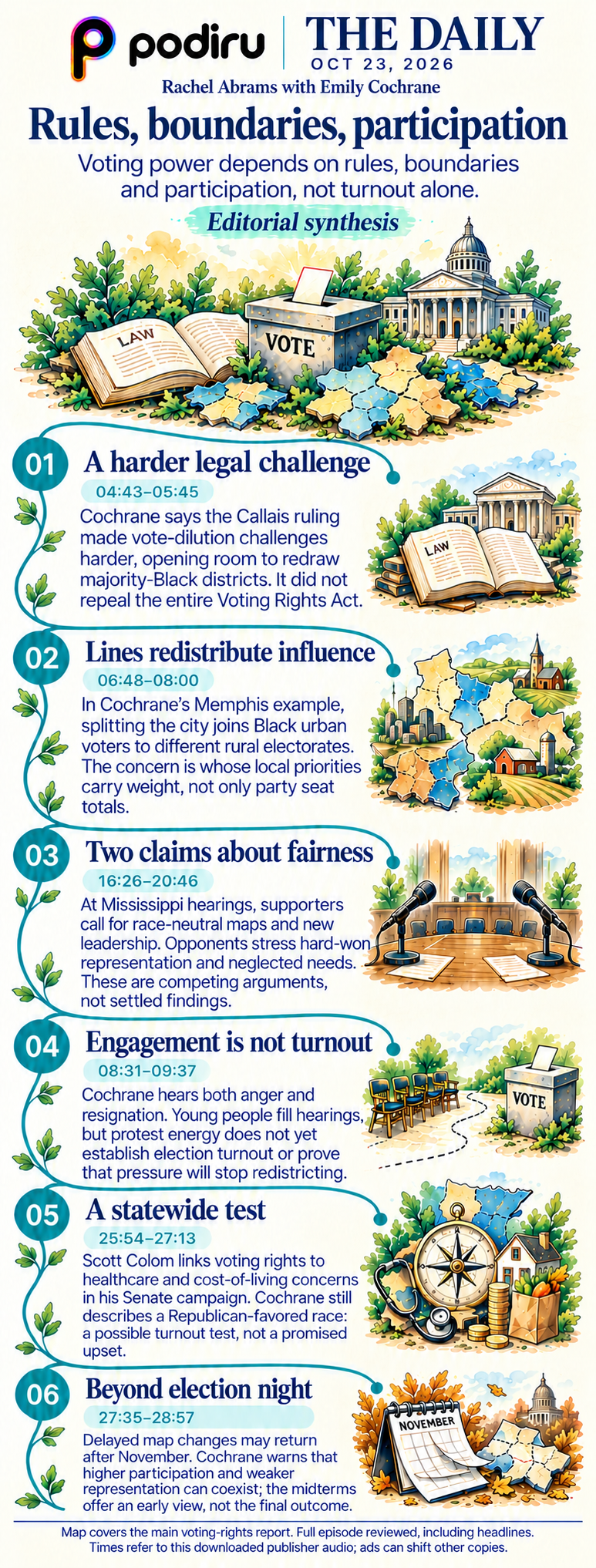
Voting power depends on rules, boundaries and participation, not turnout alone.
- 01
A harder legal challenge
Cochrane says the Callais ruling made vote-dilution challenges harder, opening room to redraw majority-Black districts. It did not repeal the entire Voting Rights Act.
Why it matters · our reading A changed legal standard removes a constraint on partisan mapmaking; the episode connects the court decision to state-level choices.
Keep in mind: The implications are Cochrane’s reporting. Do not label the entire Voting Rights Act abolished or imply the Court ordered every state to redraw.
Source passage: 04:43–05:45
- 02
Lines redistribute influence
In Cochrane’s Memphis example, splitting the city joins Black urban voters to different rural electorates. The concern is whose local priorities carry weight, not only party seat totals.
Why it matters · our reading Changing which communities vote together changes the coalition a representative must answer to, even when individual residents still cast ballots.
Keep in mind: Specific map effects are reported by the episode; this is not an independently reconstructed district map or a prediction of every election.
Source passage: 06:48–08:00
- 03
Two claims about fairness
At Mississippi hearings, supporters call for race-neutral maps and new leadership. Opponents stress hard-won representation and neglected needs. These are competing arguments, not settled findings.
Why it matters · our reading The disagreement concerns both how representatives should be chosen and whether communities have meaningful power to secure services.
Keep in mind: Shad White’s criticism of Bennie Thompson and residents’ claims about political motives remain attributed arguments, not established causal explanations.
Source passage: 16:26–20:46
- 04
Engagement is not turnout
Cochrane hears both anger and resignation. Young people fill hearings, but protest energy does not yet establish election turnout or prove that pressure will stop redistricting.
Why it matters · our reading A perceived loss of influence can motivate participation or deepen disengagement. The episode presents both responses instead of assuming a single effect.
Keep in mind: Hearing participants are not a representative sample of all voters. The turnout effect remains an open question.
Source passage: 08:31–09:37
- 05
A statewide test
Scott Colom links voting rights to healthcare and cost-of-living concerns in his Senate campaign. Cochrane still describes a Republican-favored race: a possible turnout test, not a promised upset.
Why it matters · our reading A statewide campaign offers a separate test of whether anger over district boundaries can become a broader, more reliable voting coalition.
Keep in mind: Senate voting is statewide; this campaign cannot itself restore a House district. The episode does not establish that redistricting alone determines voters’ choices.
Source passage: 25:54–27:13
- 06
Beyond election night
Delayed map changes may return after November. Cochrane warns that higher participation and weaker representation can coexist; the midterms offer an early view, not the final outcome.
Why it matters · our reading Election timing can postpone a legislature’s decision without resolving the underlying conflict over district boundaries.
Keep in mind: Future map changes are possibilities, not completed events. The episode’s early-turnout observation is not a final turnout result.
Source passage: 27:35–28:57
How the ideas connect
The legal baseline changes the choices available to mapmakers. The Memphis example explains what changing boundaries can do. Mississippi’s hearings reveal competing definitions of fairness and the uncertain bridge from anger to participation. The statewide Senate race is a test of mobilization, while the long-term map fight remains unresolved. These links describe the episode’s argument, not a causal forecast.
Full-episode overview
Rachel Abrams and reporter Emily Cochrane examine the interaction between the Supreme Court’s Louisiana v. Callais decision and mid-decade redistricting. Cochrane describes a higher hurdle for vote-dilution challenges and compares Southern states that moved ahead with new maps with states that deferred them. Memphis illustrates how splitting a community among districts can dilute its leverage over local priorities.
The report then focuses on Mississippi, where Bennie Thompson’s majority-Black House district is under discussion. Public-hearing excerpts preserve two arguments: supporters of redrawing emphasize race-neutral rules and dissatisfaction with current leadership; opponents invoke the history of exclusion, the value of representation and urgent community needs. Young participants and older organizers express determination, while Cochrane also reports apathy and cautions against assuming that visible protest will become durable turnout.
Scott Colom’s Senate campaign supplies a possible statewide test of mobilization around voting rights alongside healthcare and affordability. The episode still describes the race as favoring Republicans and does not predict an upset. Cochrane closes by warning that delayed map changes can return after the midterms. A campaign-trail update notes prominent surrogates for both Senate candidates.
Outside the main report, the news roundup covers a reported criminal investigation of a former Trump adviser, including his lawyer’s denial, and a New York City Council vote concerning horse-drawn carriages. Those separate headlines, sponsor messages, credits and the farewell were reviewed but are not mapped.
Sources & the fine print
Complete machine-transcript review of the downloaded publisher audio, with targeted retranscription of flagged spans. Not a claimed manual end-to-end audio listen. Interpretations and material caveats are labeled; display times round outward and may shift in differently ad-inserted copies.
- Episode
- Publisher feed
- Supreme Court opinion, for case spelling and legal scope
- Bennie Thompson official biography, for identity
- Mississippi State Auditor directory, for Shad White’s identity
- Map covers the main voting-rights report. Full episode reviewed, including headlines. Times refer to this downloaded publisher audio; ads can shift other copies.
Chart-informed editorial collection using Apple Podcasts trending episode charts, retrieved October 24, 2026. Not verified annual episode-level listening totals.