

THE CENTRAL IDEA · OUR READING
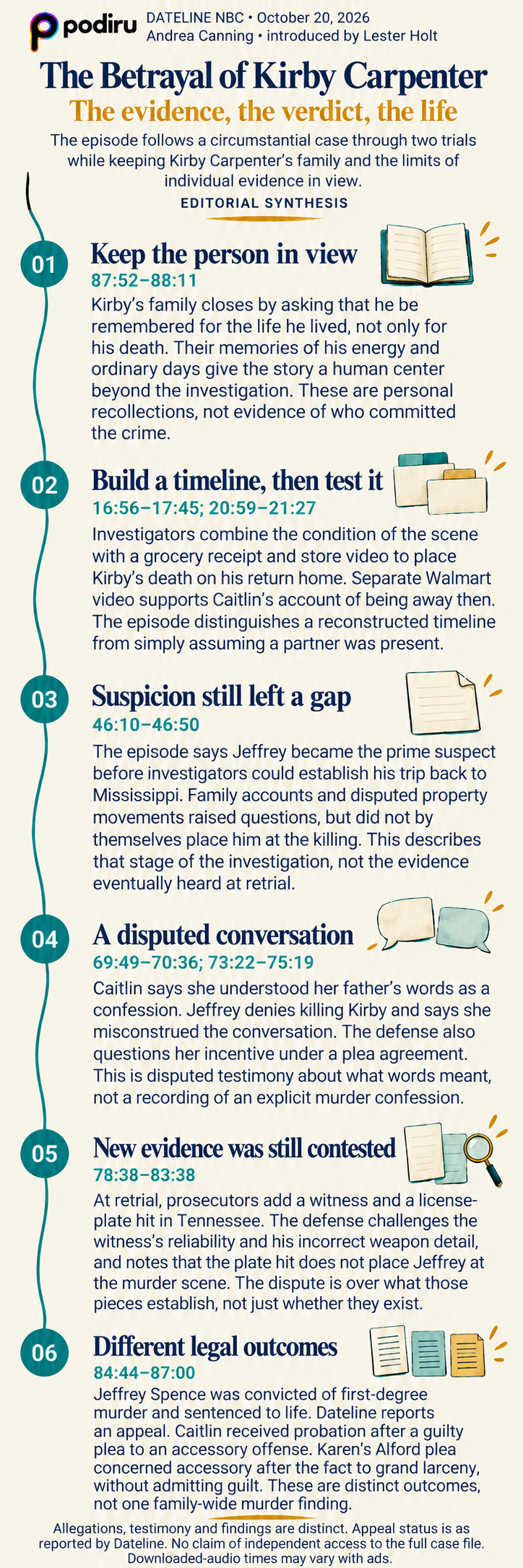
The episode follows a circumstantial case through two trials while keeping Kirby Carpenter’s family and the limits of individual evidence in view.
- 01
Keep the person in view
Kirby’s family closes by asking that he be remembered for the life he lived, not only for his death. Their memories of his energy and ordinary days give the story a human center beyond the investigation. These are personal recollections, not evidence of who committed the crime.
Why it matters · our reading A victim’s identity is larger than the evidence, suspected motive or legal outcome attached to their death.
Keep in mind: No private details about the children are needed to preserve this point. Their names, images and custody arrangements are omitted from the map.
Source passage: 87:52–88:11
- 02
Build a timeline, then test it
Investigators combine the condition of the scene with a grocery receipt and store video to place Kirby’s death on his return home. Separate Walmart video supports Caitlin’s account of being away then. The episode distinguishes a reconstructed timeline from simply assuming a partner was present.
Why it matters · our reading Different records test a narrative from different directions; an investigator’s inference is not the same kind of evidence as a recorded observation.
Keep in mind: The brief reports Dateline’s reconstruction and does not claim to have independently examined the raw surveillance files or forensic records.
Source passage: 16:56–17:45; 20:59–21:27
- 03
Suspicion still left a gap
The episode says Jeffrey became the prime suspect before investigators could establish his trip back to Mississippi. Family accounts and disputed property movements raised questions, but did not by themselves place him at the killing. This describes that stage of the investigation, not the evidence eventually heard at retrial.
Why it matters · our reading A reason to investigate is different from evidence that establishes the act, route or identity of a perpetrator.
Keep in mind: Earlier family allegations are not independently established here. Later searches, testimony and vehicle evidence changed the case presented to jurors.
Source passage: 46:10–46:50
- 04
A disputed conversation
Caitlin says she understood her father’s words as a confession. Jeffrey denies killing Kirby and says she misconstrued the conversation. The defense also questions her incentive under a plea agreement. This is disputed testimony about what words meant, not a recording of an explicit murder confession.
Why it matters · our reading The account, the speaker’s interpretation and the opposing explanation must be kept distinct when describing contested testimony.
Keep in mind: The jury later convicted Jeffrey. Reporting the defense challenge does not erase that finding; reporting Caitlin’s interpretation does not turn it into a verbatim confession.
Source passage: 69:49–70:36; 73:22–75:19
- 05
New evidence was still contested
At retrial, prosecutors add a witness and a license-plate hit in Tennessee. The defense challenges the witness’s reliability and his incorrect weapon detail, and notes that the plate hit does not place Jeffrey at the murder scene. The dispute is over what those pieces establish, not just whether they exist.
Why it matters · our reading An additional piece of evidence can strengthen a case while still leaving questions about reliability and what can reasonably be inferred from it.
Keep in mind: The brief does not identify the recovered shotgun as a ballistically matched murder weapon. The additional contextual pass retains the explicit no-direct-proof response, but the preceding clause remains ambiguous in ASR and is neither quoted nor silently repaired.
Source passage: 78:38–83:38
- 06
Different legal outcomes
Jeffrey Spence was convicted of first-degree murder and sentenced to life. Dateline reports an appeal. Caitlin received probation after a guilty plea to an accessory offense. Karen’s Alford plea concerned accessory after the fact to grand larceny, without admitting guilt. These are distinct outcomes, not one family-wide murder finding.
Why it matters · our reading Initial charges, witness cooperation, a jury verdict and separate pleas are different legal events and must not be collapsed into a single conclusion.
Keep in mind: Court TV reports acquittal on capital murder and manslaughter; MDOC independently records a murder life sentence dated March 27, 2026. The live appeal docket was not checked. Karen’s Alford plea is not an admission to the factual allegation, and neither woman is described as convicted of murder.
Source passage: 84:44–87:00; 64:12–64:54
How the ideas connect
The timeline and initial leads establish what investigators knew at successive stages. Family accounts and missing records generate suspicions, but the first trial exposes evidentiary gaps and contested testimony. The retrial adds material without removing the need to test its meaning. The legal-outcomes chapter separates the jury’s murder finding from accessory pleas and the reported appeal; the remembrance chapter keeps the victim’s life from becoming merely a case label. This structure is editorial synthesis, not an independent finding about every disputed allegation.
Full-episode overview
Andrea Canning reports on the killing of Kirby Carpenter in Tippah County, Mississippi, introduced by Lester Holt under the exact title The Betrayal of Kirby Carpenter. Family members describe Kirby’s life and business activity before the investigation begins. Investigators reconstruct a timeline from the scene, receipts and surveillance. The episode says Walmart video supported Caitlin Spence’s account of being away at the relevant time. Initial business-dispute leads are investigated and set aside rather than treated here as continuing accusations against those individuals.
Missing camera storage, disputed handling of Kirby’s property, phone and travel records, and accounts from Jeffrey Spence’s other daughter and her husband shift investigators’ attention. Dateline explicitly distinguishes suspicion at this stage from proof that Jeffrey was at the scene. The earlier family conflict and alleged threats are presented as those interviewees’ accounts; Jeffrey later disputes them. His prior offense is not used as proof of murder. A later statement by David Barnes helps investigators move toward arrests; Caitlin denies the conversation Barnes attributes to her. No private details about the children or operational evasion techniques are reproduced.
Caitlin eventually describes words she interpreted as an admission by her father. She denies advance knowledge or involvement in the killing. Her plea agreement requires truthful testimony, while the defense attacks both her interpretation and the incentive created by the agreement. The prosecution presents property recovered in searches and a shotgun, but the episode does not establish a ballistic match. Jeffrey speaks directly to Canning, denies killing Kirby and offers different explanations for the disputed conversations and messages. A coded-message interpretation remains the prosecutor’s argument, not an established translation. The first jury deadlocks and the court declares a mistrial.
At the March 2026 retrial, additional testimony and a vehicle-plate hit are presented. The defense challenges the new witness’s credibility and incorrect weapon description, and emphasizes that the plate hit is not direct proof of Jeffrey’s presence at the murder scene. The jury convicts him of first-degree murder, and he receives life in prison. Court TV reports that the verdict was not capital murder; the official MDOC record corroborates a murder life sentence dated March 27, 2026. Dateline reports that he is appealing, but a current appeal docket was not independently reviewed. Caitlin’s guilty plea to an accessory offense and Karen’s Alford plea to accessory after the fact to grand larceny lead to probationary outcomes reported in the episode. Neither is described here as a murder conviction, and Karen’s plea is not represented as an admission of the factual allegation. The program ends with the family’s wish to remember Kirby’s life. All sponsor segments, promos and credits were also reviewed and excluded from the substantive brief.
Sources & the fine print
Complete machine-transcript review of the downloaded publisher audio, with targeted retranscription of flagged spans. Not a claimed manual end-to-end audio listen. Interpretations and material caveats are labeled; display times round outward and may shift in differently ad-inserted copies.
- NBC publisher feed: The Betrayal of Kirby Carpenter
- Mississippi Department of Corrections: Jeffrey Spence sentence record
- Court TV: Jeffrey Spence convicted at retrial
- Court TV: second-trial verdict recording page
- Karen Spence plea reporting, citing Tippah court documents
- Allegations, testimony and findings are distinct. Appeal status is as reported by Dateline. No claim of independent access to the full case file. Downloaded-audio times may vary with ads.
Chart-informed editorial collection using Apple Podcasts trending episode charts, retrieved October 24, 2026. Not verified annual episode-level listening totals.