

THE CENTRAL IDEA · OUR READING
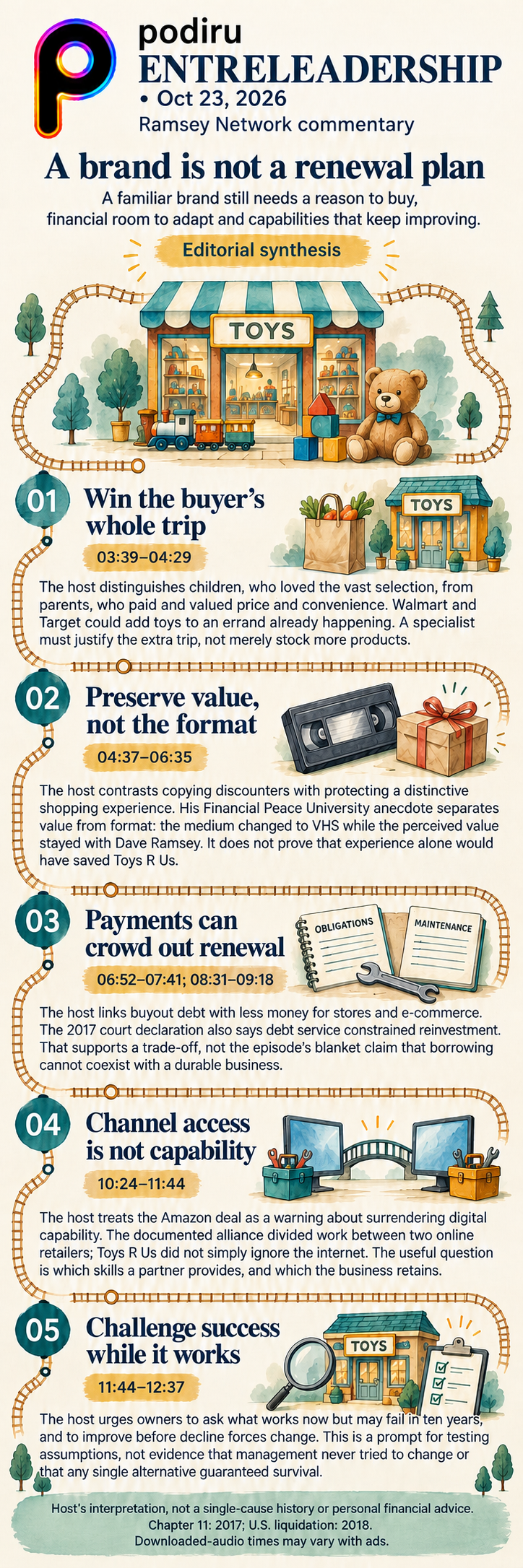
A familiar brand still needs a reason to buy, financial room to adapt and capabilities that keep improving.
- 01
Win the buyer’s whole trip
The host distinguishes children, who loved the vast selection, from parents, who paid and valued price and convenience. Walmart and Target could add toys to an errand already happening. A specialist must justify the extra trip, not merely stock more products.
Why it matters · our reading The product user and the purchasing decision-maker can value different things. Selection competes with the time and effort of a separate shopping trip.
Keep in mind: This is the host’s explanation, not a representative survey of parents or a claim that every family preferred the same shopping experience.
Source passage: 03:39–04:29
- 02
Preserve value, not the format
The host contrasts copying discounters with protecting a distinctive shopping experience. His Financial Peace University anecdote separates value from format: the medium changed to VHS while the perceived value stayed with Dave Ramsey. It does not prove that experience alone would have saved Toys R Us.
Why it matters · our reading Identify what customers would actually miss before copying a rival’s pricing or preserving an old delivery method. The distinctive benefit and the current format are not necessarily the same.
Keep in mind: The VHS story is an anecdote from the publisher’s own business. The proposed alternative for Toys R Us is a counterfactual, not a demonstrated rescue plan.
Source passage: 04:37–06:35
- 03
Payments can crowd out renewal
The host links buyout debt with less money for stores and e-commerce. The 2017 court declaration also says debt service constrained reinvestment. That supports a trade-off, not the episode’s blanket claim that borrowing cannot coexist with a durable business.
Why it matters · our reading Obligations can reduce financial room for adaptation precisely when competitive pressure makes investment more urgent. The relevant question is resilience under stress, not growth alone.
Keep in mind: The declaration describes roughly $400 million in annual cash debt service, not necessarily interest alone. It is management’s account of multiple pressures. Cash-only growth is EntreLeadership’s philosophy, not a universal financing rule.
Source passage: 06:52–07:41; 08:31–09:18
- 04
Channel access is not capability
The host treats the Amazon deal as a warning about surrendering digital capability. The documented alliance divided work between two online retailers; Toys R Us did not simply ignore the internet. The useful question is which skills a partner provides, and which the business retains.
Why it matters · our reading Access to an online storefront and control of its technical, fulfillment and service capabilities are different assets. Partnership design matters more than a simple online-versus-offline label.
Keep in mind: In 2000, Toys R Us retained inventory selection and management while Amazon handled site development, fulfillment and customer service. Amazon’s 2006 filing records a court judgment terminating the agreement, then under appeal. The episode compresses that history; outsourcing alone is not established as the cause of failure.
Source passage: 10:24–11:44
- 05
Challenge success while it works
The host urges owners to ask what works now but may fail in ten years, and to improve before decline forces change. This is a prompt for testing assumptions, not evidence that management never tried to change or that any single alternative guaranteed survival.
Why it matters · our reading Reviewing the durability of a customer benefit before performance deteriorates leaves more options than waiting for a crisis. This connects customer value, financial room and capabilities without pretending to prove one inevitable causal chain.
Keep in mind: The 2017 declaration describes turnaround initiatives and limited investments as well as constraints. Calling the whole history complacency is the host’s interpretation, not a complete account of management actions or bankruptcy causation.
Source passage: 11:44–12:37
How the ideas connect
1. The origin story explains why selection was once an advantage; the parent-convenience discussion shows why that benefit alone could weaken. 2. Differentiation asks what to preserve, while the debt discussion asks what resources remain to renew it. The connections are an editorial reading, not quantified causal effects. 3. The Amazon section moves from financial resources to operating capabilities; its partnership history complicates a simple claim that Toys R Us stayed offline. 4. The ten-year question brings the three concerns together. The ending’s 2017 filing and 2018 U.S. liquidation are distinct events, not an instant disappearance or proof of a single cause.
Full-episode overview
After an EntreLeadership Master Series promotion, the episode frames Toys R Us as a once-dominant retailer that made three avoidable mistakes. Its opening history describes Charles Lazarus, the shift from baby furniture to toys, the superstore’s enormous selection, and the later pressure from discounters. Those historical examples set up the host’s first argument: the company lost sight of its distinctive value while competitors offered parents lower prices and the convenience of buying toys during other errands.
The first lesson expands beyond retail. The host uses a Financial Peace University VHS anecdote and a punctual, careful plumber to argue that customers buy a distinctive benefit rather than a particular format. The second lesson concerns the 2005 leveraged buyout and debt payments that could otherwise have supported store and online improvements. The host then advocates cash-funded growth and reducing debt, with examples from coaching business owners. That is EntreLeadership’s financial philosophy, not a general conclusion that every use of borrowing is unsound. A BELAY assistant-service advertisement follows.
The final major section treats complacency and the Amazon partnership as warnings about losing future capabilities. A primary-source check adds important context: the 2000 arrangement was an alliance between existing online retailers with divided responsibilities, not an absence of e-commerce. Amazon’s 2006 filing records a court decision terminating it, then under appeal. The host’s forward-looking question is whether what works now will still serve customers ten years later.
The close revisits competition, outdated stores and financial constraints, mentions Chapter 11 and a proposed revival, then promotes Dave Ramsey’s Build a Business You Love and another episode about Spirit Airlines. The chronology needs care: Chapter 11 began in September 2017; the U.S. liquidation process followed in 2018. The September 2026 Toys R Us announcement corroborates a plan for 120 new standalone holiday stores, not proof that all had opened or that the revived model will succeed. Later brand operations must not be equated with uninterrupted survival of the former U.S. chain. All promotions, advertisements and the ending were reviewed; they are not endorsed or treated as independent evidence for the business lessons.
Sources & the fine print
Complete machine-transcript review of the downloaded publisher audio, with targeted retranscription of flagged spans. Not a claimed manual end-to-end audio listen. Interpretations and material caveats are labeled; display times round outward and may shift in differently ad-inserted copies.
- Selected episode and listening page
- EntreLeadership publisher RSS
- Toys R Us September 2017 Chapter 11 filing
- David Brandon’s September 2017 court declaration
- Amazon and Toysrus.com August 2000 alliance announcement
- Amazon March 2006 quarterly filing
- Toys R Us March 2018 wind-down filing
- Toys R Us September 2026 holiday-expansion announcement
- Host’s interpretation, not a single-cause history or personal financial advice. Chapter 11: 2017; U.S. liquidation: 2018. Downloaded-audio times may vary with ads.
Chart-informed editorial collection using Apple Podcasts trending episode charts, retrieved October 24, 2026. Not verified annual episode-level listening totals.