

THE CENTRAL IDEA · OUR READING
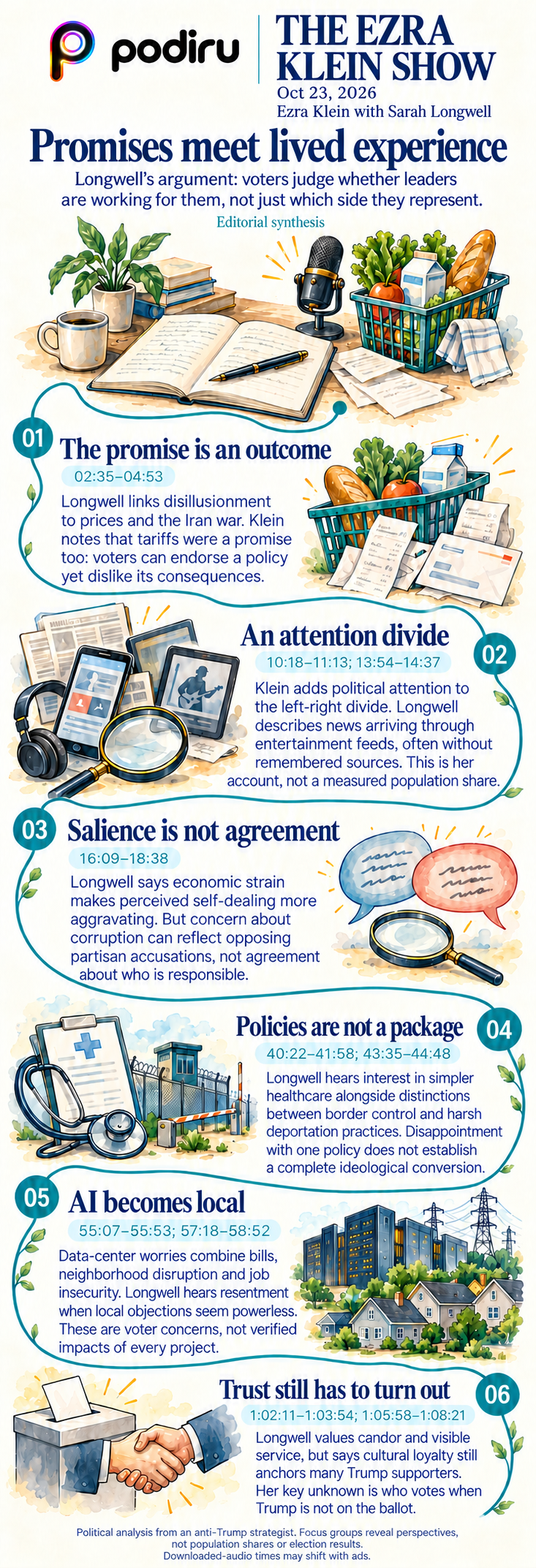
Longwell’s argument: voters judge whether leaders are working for them, not just which side they represent.
- 01
The promise is an outcome
Longwell links disillusionment to prices and the Iran war. Klein notes that tariffs were a promise too: voters can endorse a policy yet dislike its consequences.
Why it matters · our reading Longwell distinguishes the outcome people hoped for, lower household costs and domestic attention, from the policy details offered as the route to it. Klein challenges the idea that tariffs were unpromised.
Keep in mind: This is the speakers’ interpretation of voter experience, not a quantified causal estimate of tariff or war effects.
Source passage: 02:35–04:53
- 02
An attention divide
Klein adds political attention to the left-right divide. Longwell describes news arriving through entertainment feeds, often without remembered sources. This is her account, not a measured population share.
Why it matters · our reading People who encounter politics incidentally may build impressions from cultural fragments rather than sustained news consumption. That can make an analyst’s issue-by-issue model a poor description of how opinions form.
Keep in mind: Focus groups supply qualitative accounts. They do not establish the prevalence of this behavior or make all less-engaged voters alike.
Source passage: 10:18–11:13; 13:54–14:37
- 03
Salience is not agreement
Longwell says economic strain makes perceived self-dealing more aggravating. But concern about corruption can reflect opposing partisan accusations, not agreement about who is responsible.
Why it matters · our reading The same issue label can gather incompatible interpretations. An issue rising in importance therefore does not automatically create an advantage for the party trying to emphasize it.
Keep in mind: The episode includes allegations and partisan rhetoric about named people; this brief does not independently adjudicate them or repeat unverified transaction figures.
Source passage: 16:09–18:38
- 04
Policies are not a package
Longwell hears interest in simpler healthcare alongside distinctions between border control and harsh deportation practices. Disappointment with one policy does not establish a complete ideological conversion.
Why it matters · our reading A voter can want stricter border control, object to particular enforcement methods, and seek a more affordable healthcare system. These positions need not move together on a single left-right scale.
Keep in mind: The universal-healthcare discussion is a political forecast, not a concrete agreed plan. The participants’ immigration views are not estimates for all Trump voters.
Source passage: 40:22–41:58; 43:35–44:48
- 05
AI becomes local
Data-center worries combine bills, neighborhood disruption and job insecurity. Longwell hears resentment when local objections seem powerless. These are voter concerns, not verified impacts of every project.
Why it matters · our reading The technology debate becomes personal when people connect a local development to household costs, work and control over their community. The speakers resist treating the issue as a settled partisan divide.
Keep in mind: The episode reports perceptions and local anecdotes, not a technical impact assessment. Claimed electricity, tax and job numbers are omitted.
Source passage: 55:07–55:53; 57:18–58:52
- 06
Trust still has to turn out
Longwell values candor and visible service, but says cultural loyalty still anchors many Trump supporters. Her key unknown is who votes when Trump is not on the ballot.
Why it matters · our reading Longwell distinguishes explaining uncertainty and helping constituents from simple message polishing. She also separates liking a candidate or defending Trump from being motivated to vote in a midterm.
Keep in mind: These are her strategic judgments and turnout hypotheses. Focus-group enthusiasm cannot establish a future election result. She is an anti-Trump political strategist.
Source passage: 1:02:11–1:03:54; 1:05:58–1:08:21
How the ideas connect
The opening separates promised outcomes from policy tools. The attention discussion explains why impressions may not follow detailed policy arguments. Corruption shows how a shared issue label can conceal opposing views. Healthcare and immigration challenge a single-axis portrait of voters. AI makes the same trust question local. The closing turnout discussion limits what any of these observations can predict.
Full-episode overview
Ezra Klein interviews Bulwark publisher and anti-Trump strategist Sarah Longwell about what she hears in voter focus groups. Longwell explains declining enthusiasm through a gap between hoped-for improvements in everyday life and the outcomes participants associate with tariffs and the Iran war. Klein complicates the promise-breaking account by noting that Trump openly campaigned on tariffs. Their distinction is between endorsing a proposed tool and liking its lived consequences.
They then examine how political attention shapes interpretation. Longwell describes people encountering news incidentally through entertainment and algorithmic feeds. On corruption, she offers two mechanisms: economic frustration sharpens resentment of perceived self-dealing, while competing partisan accusations can make the same issue prominent for people who mean very different things. She praises Jon Ossoff’s step-by-step storytelling rather than treating a rising concern about corruption as automatic support for Democrats. The episode includes specific allegations, but this brief does not present those accusations as adjudicated facts.
The transparency discussion centers on disappointed expectations about releasing Epstein-related material, not proof of any individual’s criminal involvement. The Iran discussion moves from expectations of a short intervention to frustration over its persistence and household costs. Klein explicitly distinguishes ordinary criticism of alliance decisions from conspiracy claims of hidden control; the speakers warn about antisemitic scapegoating rather than endorsing it.
On affordability, Klein distinguishes a lower inflation rate from a lower price level. Longwell argues that the next administration would need to acknowledge difficult trade-offs instead of declaring that people’s finances are fine. They speculate about growing demand for simpler, cheaper healthcare. Their discussion of immigration emphasizes that supporting border control does not necessarily entail supporting every deportation tactic. They also debate masked enforcement, accountability, anger and turnout; these are political interpretations, not a neutral estimate of every voter’s views.
Data centers connect abstract AI debates to electricity bills, community disruption, job uncertainty and a feeling that local objections do not matter. Longwell argues for candid explanation of unresolved choices, not merely taking the opposite position to Republicans. Klein notes that elected officials themselves often lack settled answers. In the closing candidate discussion, Longwell praises communication and constituent service, while acknowledging that cultural issues and partisan identity still sustain substantial Trump support. The unresolved question is how enthusiasm and disappointment translate into participation when Trump is not personally on the ballot.
The conversation ends with Longwell’s fiction recommendations: Intermezzo by Sally Rooney, Stoner by John Williams, and The Poisonwood Bible by Barbara Kingsolver. The publisher promotions and farewell were reviewed but are not mapped.
Sources & the fine print
Complete machine-transcript review of the downloaded publisher audio, with targeted retranscription of flagged spans. Not a claimed manual end-to-end audio listen. Interpretations and material caveats are labeled; display times round outward and may shift in differently ad-inserted copies.
- Episode
- Publisher feed
- Longwell’s own publisher, for identity, book and political perspective
- Jon Ossoff’s official biography, for name spelling only
- Political analysis from an anti-Trump strategist. Focus groups reveal perspectives, not population shares or election results. Downloaded-audio times may shift with ads.
Chart-informed editorial collection using Apple Podcasts trending episode charts, retrieved October 24, 2026. Not verified annual episode-level listening totals.