

THE CENTRAL IDEA · OUR READING
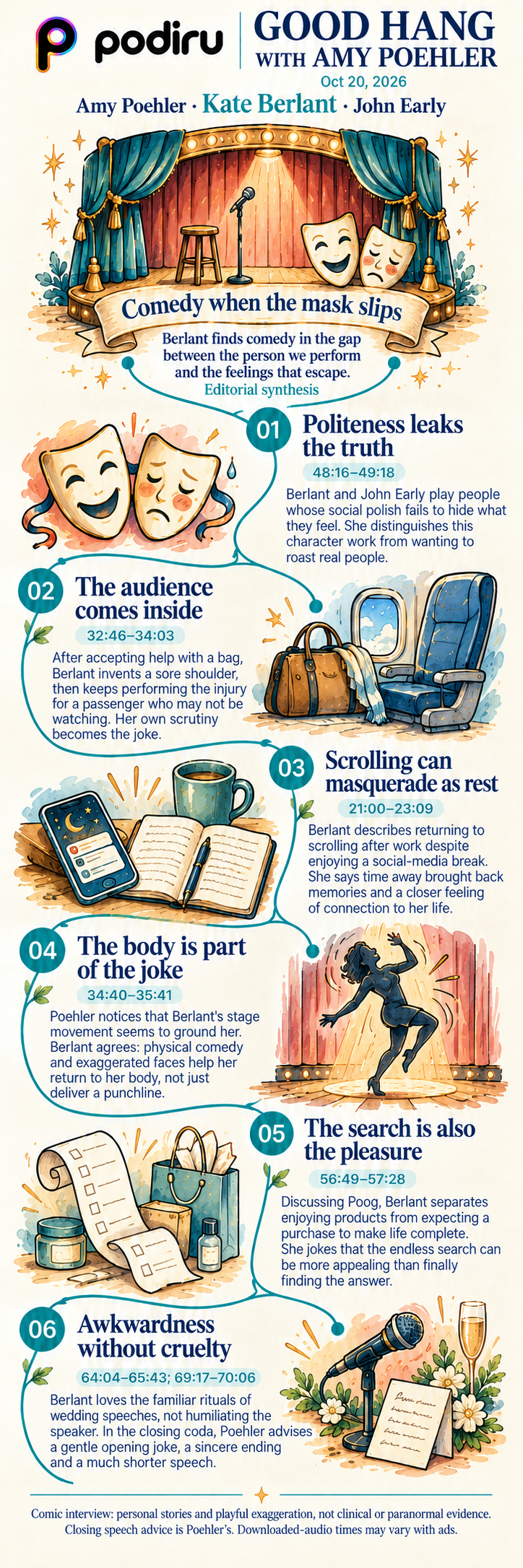
Berlant finds comedy in the gap between the person we perform and the feelings that escape.
- 01
Politeness leaks the truth
Berlant and John Early play people whose social polish fails to hide what they feel. She distinguishes this character work from wanting to roast real people.
Why it matters · our reading The mismatch between courteous delivery and exposed feeling explains the comic engine of their partnership.
Keep in mind: This is the performers’ account of their style, not a diagnosis of their personalities or proof about their childhoods.
Source passage: 48:16–49:18; 07:42–09:37
- 02
The audience comes inside
After accepting help with a bag, Berlant invents a sore shoulder, then keeps performing the injury for a passenger who may not be watching. Her own scrutiny becomes the joke.
Why it matters · our reading An ordinary social favor becomes a miniature performance sustained by an imagined audience.
Keep in mind: An autobiographical comic anecdote, not advice to fake an injury or a universal claim about gender.
Source passage: 32:46–34:03
- 03
Scrolling can masquerade as rest
Berlant describes returning to scrolling after work despite enjoying a social-media break. She says time away brought back memories and a closer feeling of connection to her life.
Why it matters · our reading Her tension is between how unwinding looks in the moment and how she experiences it afterward.
Keep in mind: Personal experience, not clinical evidence or a prescribed detox. Her break still allowed email and texting.
Source passage: 21:00–23:09
- 04
The body is part of the joke
Poehler notices that Berlant’s stage movement seems to ground her. Berlant agrees: physical comedy and exaggerated faces help her return to her body, not just deliver a punchline.
Why it matters · our reading The exchange makes physical performance part of Berlant’s creative process rather than decoration around the words.
Keep in mind: The speakers describe their own experience. This is not a mental-health treatment claim.
Source passage: 34:40–35:41
- 05
The search is also the pleasure
Discussing Poog, Berlant separates enjoying products from expecting a purchase to make life complete. She jokes that the endless search can be more appealing than finally finding the answer.
Why it matters · our reading The joke holds consumer pleasure and skepticism together instead of pretending one cancels the other.
Keep in mind: Comic reflection on consumption, not evidence that a product works or a recommendation to buy anything.
Source passage: 56:49–57:28
- 06
Awkwardness without cruelty
Berlant loves the familiar rituals of wedding speeches, not humiliating the speaker. In the closing coda, Poehler advises a gentle opening joke, a sincere ending and a much shorter speech.
Why it matters · our reading The ending turns their interest in vulnerable performances into Poehler’s explicitly offered, modest speaking advice.
Keep in mind: The practical advice is Poehler’s, not Berlant’s. Neither promises every joke will land; both reject humiliation.
Source passage: 64:04–65:43; 69:17–70:06
How the ideas connect
1. Early’s opening description of polished authority and passive aggression connects with Berlant’s later explanation of character masks. 2. Phone habits, gendered expectations and the airplane story all explore the tension between immediate behavior and self-observation. This is an editorial thematic link, not a causal claim. 3. The physical-performance exchange shifts from social masks to what performing feels like in Berlant’s body. 4. Product searching, ghost banter and city talk broaden the interview into desire, belief and everyday absurdity without establishing medical or paranormal facts. 5. Wedding speeches return to performed social rituals; Poehler’s separate closing coda adds the episode’s clearest practical advice.
Full-episode overview
Poehler first talks with John Early about his creative rapport with Berlant. Their attraction to passive aggression, performed authority and the mismatch between outward polish and inward feeling sets up the main interview. Once Berlant arrives, they move from playful green-room and hair talk to the deliberately funny title of her special, Parmesan, then to her uneasy relationship with scrolling. She describes the benefits she personally felt during social-media breaks, while acknowledging that she returned to the habit.
The middle of the conversation explores funny women, being seen and the performances people carry into relationships. Berlant discusses her own sexuality without presenting everyone’s experience as the same. Generalizations about men and heterosexual relationships are explicitly qualified. An airplane story makes the imaginary audience concrete: after inventing a shoulder problem to explain accepting help, she feels obliged to keep acting it out. Poehler then notices how Berlant’s physical comedy grounds her. Their medical-anxiety and anesthesia stories remain personal anecdotes and jokes, not health guidance.
They connect childhood mimicry in an artistic household to Berlant’s interest in ways of sounding authoritative, and she recalls doing staged radio calls early in her career. The interview returns to her partnership with Early and how character masks let them explore sharp social behavior without simply roasting real people. A chimney-sweep dispute becomes an extended comic story about conflict and an imaginary husband. Early’s questions prompt affectionate teasing, not factual claims that Berlant has children or that HBO canceled her special.
Poog and product talk hold the pleasures of shopping alongside skepticism that the perfect item will complete a life. Late rapid-fire topics include psychic and ghost stories, joking suspicion of paid curse-lifting, and Berlant’s love for Los Angeles alongside her longing for the everyday contact she associates with New York. Paranormal experiences are presented as her account, not verified phenomena. The conversation ends on wedding speeches and parties: they enjoy the awkwardness of people performing familiar rituals but say they do not want anyone humiliated. After the guest goodbye, Poehler adds her own wedding-speech advice: start gently funny, finish sincerely and shorten the speech. All opening and closing ads, credits and transitions were reviewed but excluded from the editorial argument.
Sources & the fine print
Complete machine-transcript review of the downloaded publisher audio, with targeted retranscription of flagged spans. Not a claimed manual end-to-end audio listen. Interpretations and material caveats are labeled; display times round outward and may shift in differently ad-inserted copies.
- Publisher episode and guest identity
- Publisher audio feed
- Apple episode listing
- HBO special announcement
- Comic interview: personal stories and playful exaggeration, not clinical or paranormal evidence. Closing speech advice is Poehler’s. Downloaded-audio times may vary with ads.
Chart-informed editorial collection using Apple Podcasts trending episode charts, retrieved October 24, 2026. Not verified annual episode-level listening totals.