

THE CENTRAL IDEA · OUR READING
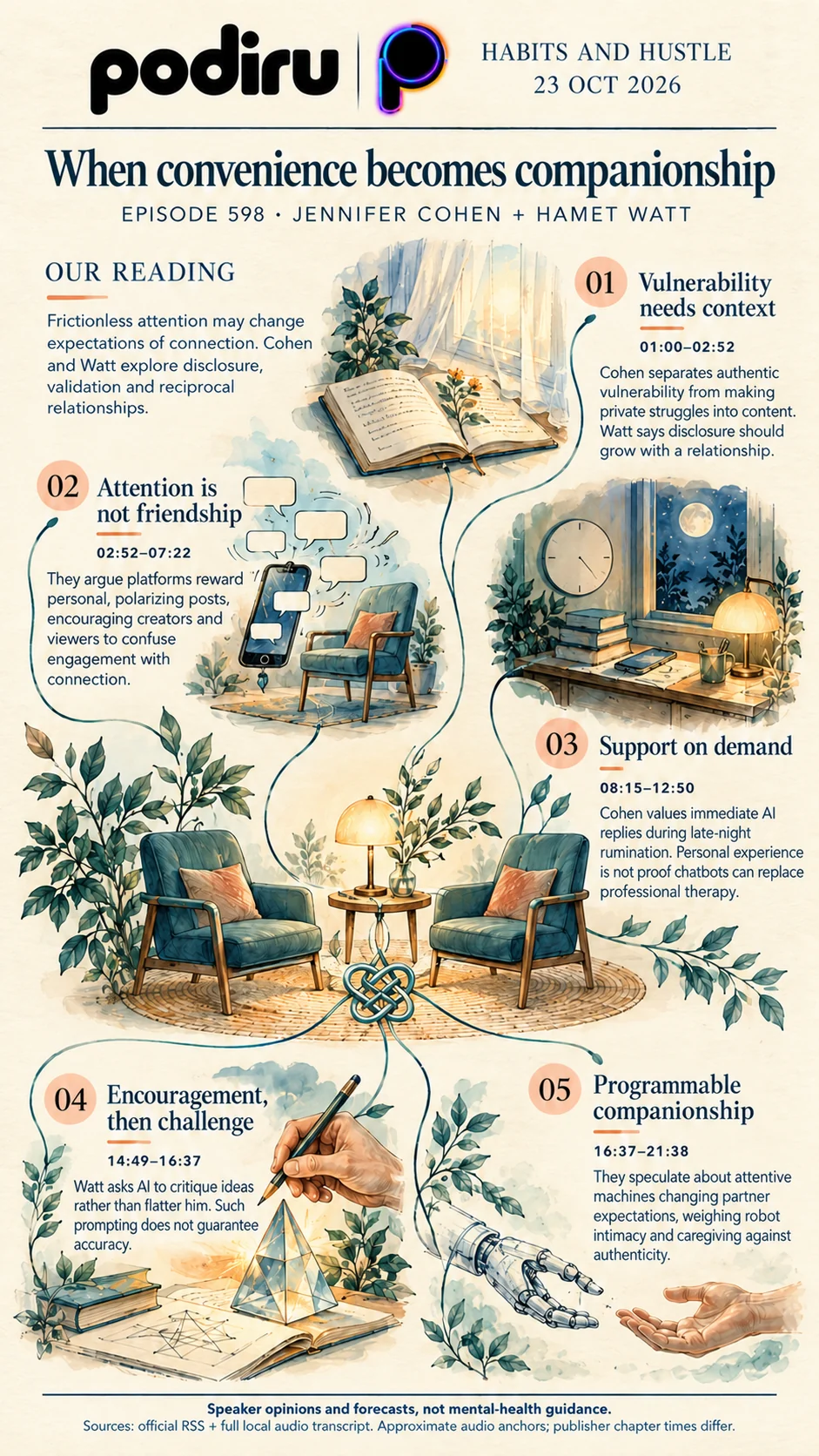
frictionless attention can meet immediate needs while changing expectations of connection. Cohen and Watt explore the trade-offs between disclosure, validation and reciprocal relationships.
- 01
Vulnerability needs context
Cohen separates authentic vulnerability from turning every private struggle into content. Watt says disclosure should grow with a relationship.
Source passage: 01:00–02:52
Original audio from 01:00 - 02
Attention is not friendship
They argue platforms reward increasingly personal, polarizing posts, encouraging lonely viewers and creators to confuse engagement with genuine connection.
Source passage: 02:52–07:22
Original audio from 02:52 - 03
Support on demand
Cohen describes valuing immediate AI replies during late-night rumination. These are personal experiences, not proof that chatbots can replace professional therapy.
Source passage: 08:15–12:50
Original audio from 08:15 - 04
Encouragement, then challenge
Watt distinguishes early encouragement from later stress-testing: he asks AI to critique ideas instead of flattering him. Such prompting does not guarantee accuracy.
Source passage: 14:49–16:37
Original audio from 14:49 - 05
Programmable companionship
They wonder whether attentive machines will change expectations of partners, then weigh speculative robot intimacy and caregiving against questions of authenticity.
Source passage: 16:37–21:38
Original audio from 16:37
A path through the episode
- 01:00 Vulnerability versus oversharing
- 07:22 AI as companion
- 08:15 Therapy comparison / anecdotes
- 15:15 Validation versus critique
- 17:06 Robots, intimacy and care
Approximate anchors follow the downloaded publisher audio and local ASR, not the publisher’s chapter times. Publisher notes have several-minute offsets, likely ad/version differences.
Sources & the fine print
Complete official publisher audio machine-transcribed and reviewed end to end. Automatic transcription can contain errors; this is not a publisher-edited transcript.
Full local machine transcript reviewed. Speaker opinions and forecasts, not mental-health guidance; sponsor claims excluded.
- Automatic transcript; small.en makes occasional name/brand errors. Host and guest spellings normalized against publisher metadata.
- The episode contains unsupported or underspecified survey/study claims about therapy and AI. Those statistics and conclusions are intentionally omitted from the visual.
- Discussion of AI as emotional support is personal experience and speculation, not clinical evidence or recommendation to replace human care.
- Predictions about human-like robots and timelines are speculative; do not convert them into product facts or dated forecasts.
- Publisher episode URL contains episode-596, while the authoritative RSS title and iTunes episode number identify this entry as 598.
Latest published entry in each show’s original publisher feed at the October 23, 2026 check, including official companion cross-posts. Episodes need not have been published in the last 24 hours. Curated shows, not a combined ranking.
Original editorial summaries based on complete episode transcripts or complete audio-derived transcripts. Speaker views, speculation and our interpretation are distinguished. No complete transcript is reproduced. Illustrations are conceptual, not measured charts.