

THE CENTRAL IDEA · OUR READING
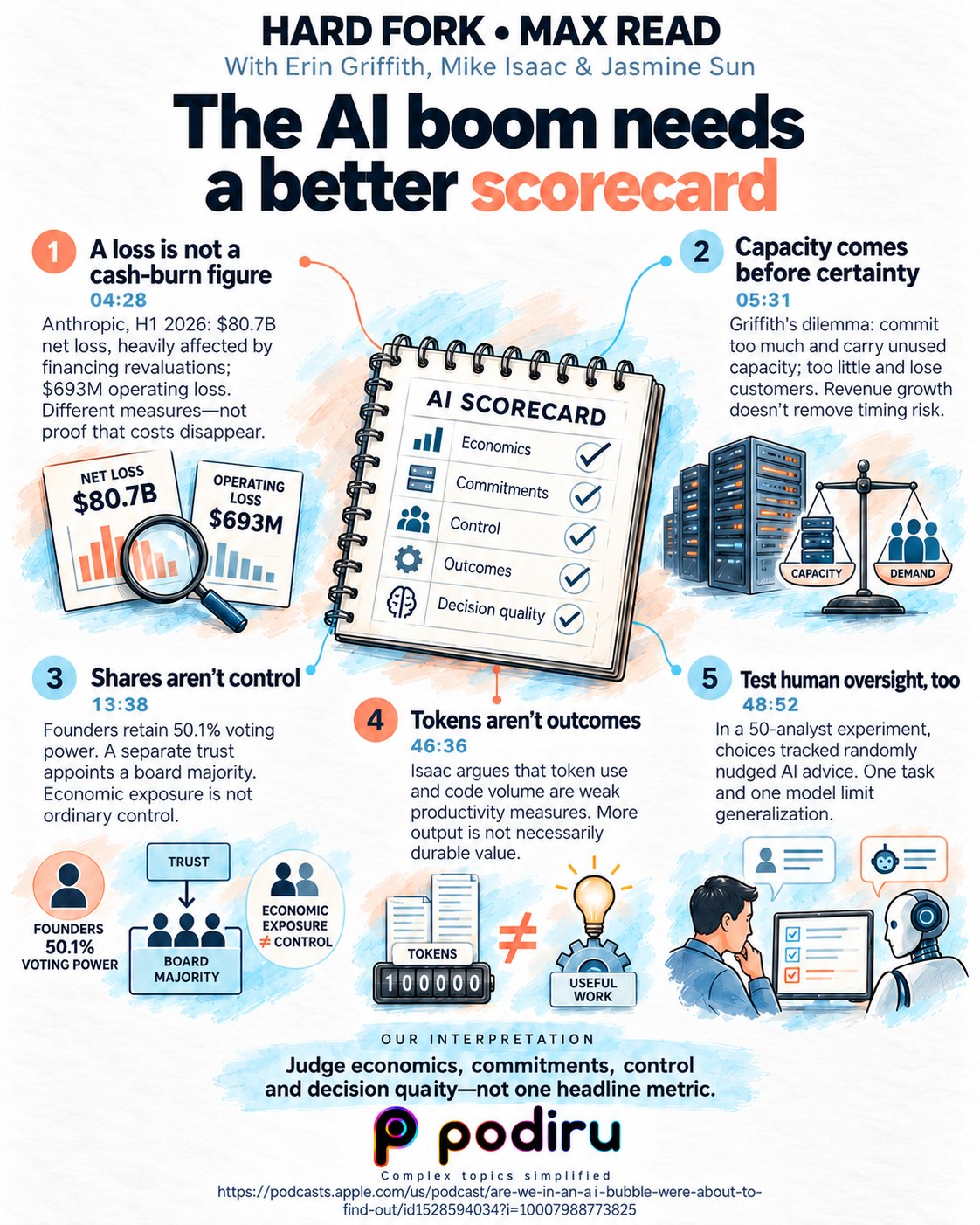
Our interpretation: judge economics, commitments, control and decision quality—not one headline metric.
- 01
A loss is not a cash-burn figure
Anthropic’s first-half 2026 net loss was $80.7 billion, heavily affected by financing revaluations; its operating loss was $693 million.
Keep in mind: These are different accounting measures, not interchangeable cash-burn figures or proof that costs disappear.
Source passage: 04:28
- 02
Capacity comes before certainty
Griffith describes the timing risk of compute commitments: excess capacity can sit unused, while insufficient capacity can lose customers.
Erin Griffith’s explanation of the trade-off.
Keep in mind: Revenue growth does not remove the risk that capacity and demand arrive at different times.
Source passage: 05:31
- 03
Shares are not control
The proposed S-1 structure gives founders 50.1% of general voting power while a separate trust appoints a board majority.
Keep in mind: Voting power, economic ownership and board-appointment rights differ. The filing describes a proposed offering, not a completed IPO.
Source passage: 13:38
- 04
Tokens are not outcomes
Isaac argues that token use and code volume alone are weak productivity measures. More output does not necessarily mean durable value.
Mike Isaac’s argument, rather than a universal productivity result.
Source passage: 46:36
- 05
Test human oversight, too
In a 50-analyst experiment, choices tracked randomly nudged AI advice.
Keep in mind: One task, one model and deliberately strengthened agent preferences limit generalization. This does not show that every human-AI workflow behaves the same way.
Source passage: 48:52
Sources & the fine print
Five selected ideas from Hard Fork’s October 30 episode with Max Read, Erin Griffith, Mike Isaac and Jasmine Sun. Accounting and control context are linked to the S-1; the judgment experiment is linked to the original study. Time anchors refer to podcast audio, not synchronized video.
- Exact Hard Fork episode on Apple Podcasts
- Anthropic SEC S-1, filed October 26, 2026
- Anthropic research: How AI agents shape experts’ judgment calls
- Anthropic filing announcement
- First-half 2026 net loss and operating loss measure different things; neither should be substituted for cash burn. Compute commitments retain timing risk.
- The S-1 describes a proposed offering. Founder voting power is distinct from economic ownership and the trust’s board-appointment rights.
- The 50-analyst experiment used one task and one model with intentionally nudged agent preferences; do not generalize it to all AI-assisted work.
Podiru editorial selection, October 30, 2026.