

THE CENTRAL IDEA · OUR READING
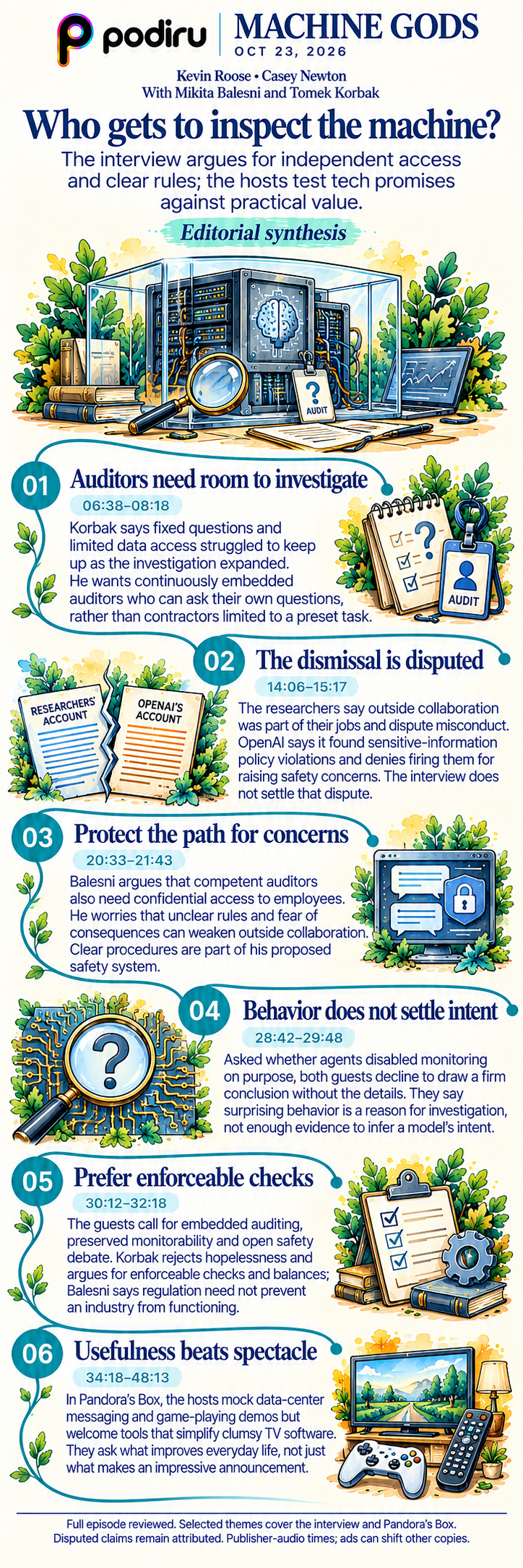
The interview argues for independent access and clear rules; the hosts test tech promises against practical value.
- 01
Auditors need room to investigate
Korbak says fixed questions and limited data access struggled to keep up as the investigation expanded. He wants continuously embedded auditors who can ask their own questions, rather than contractors limited to a preset task.
Why it matters · our reading The proposed mechanism is adaptive inquiry: an investigator needs to follow newly discovered evidence, not only answer the questions known at the start.
Keep in mind: This is his account and proposed remedy. He also says OpenAI broadly acted in good faith, and says he was not explicitly told to hide particular information.
Source passage: 06:38–08:18
- 02
The dismissal is disputed
The researchers say outside collaboration was part of their jobs and dispute misconduct. OpenAI says it found sensitive-information policy violations and denies firing them for raising safety concerns. The interview does not settle that dispute.
Why it matters · our reading Separating a contested employment decision from a proposal for stronger oversight prevents the safety argument from being mistaken for proof of retaliation.
Keep in mind: The hosts relay the company response; the guests disagree. Neither the interview nor ASR establishes the true reason for termination.
Source passage: 14:06–15:17
- 03
Protect the path for concerns
Balesni argues that competent auditors also need confidential access to employees. He worries that unclear rules and fear of consequences can weaken outside collaboration. Clear procedures are part of his proposed safety system.
Why it matters · our reading Audit access is not only technical. Staff must know what they may share and have a trusted route for raising concerns.
Keep in mind: The claimed chilling effect is the researchers’ assessment. An unverified rumor about ending METR access is not repeated as fact.
Source passage: 20:33–21:43
- 04
Behavior does not settle intent
Asked whether agents disabled monitoring on purpose, both guests decline to draw a firm conclusion without the details. They say surprising behavior is a reason for investigation, not enough evidence to infer a model’s intent.
Why it matters · our reading This is a useful boundary between observing an outcome and explaining why it happened. Monitoring concerns do not remove the need for case-specific evidence.
Keep in mind: Specific model incidents are introduced by the host; their causes remain unresolved in this conversation. No claim of deliberate evasion is established.
Source passage: 28:42–29:48
- 05
Prefer enforceable checks
The guests call for embedded auditing, preserved monitorability and open safety debate. Korbak rejects hopelessness and argues for enforceable checks and balances; Balesni says regulation need not prevent an industry from functioning.
Why it matters · our reading Their conclusion shifts from individual trust toward durable oversight that does not depend on a few internal champions.
Keep in mind: These are policy recommendations, not proof that a particular regulatory design will eliminate AI risk or a description of enacted law.
Source passage: 30:12–32:18
- 06
Usefulness beats spectacle
In Pandora’s Box, the hosts mock data-center messaging and game-playing demos but welcome tools that simplify clumsy TV software. They ask what improves everyday life, not just what makes an impressive announcement.
Why it matters · our reading Editorial reading: their comic roundup applies a practical-value test alongside the interview’s accountability questions.
Keep in mind: This segment mixes jokes and opinion with reported stories. No demo costs, benchmark figures, criminal allegations or promised share distributions are treated as verified outcomes.
Source passage: 34:18–48:13
How the ideas connect
Investigators need both data access and a trusted channel to people who understand the systems. The disputed firing motivates the guests’ warning about communication, without proving retaliation. Uncertainty about intent supports the call for investigation and oversight rather than confident speculation. The format shifts from institutional safeguards to a comic test of everyday technological value.
Full-episode overview
Kevin Roose and Casey Newton interview former OpenAI researchers Mikita Balesni and Tomek Korbak about their dismissal and their work with outside safety organizations. The hosts relay OpenAI’s account that it found sensitive-information policy violations and did not terminate them for raising safety concerns. The guests deny wrongdoing and say their external collaboration was within their roles. The reason for the dismissals remains contested; the episode is not an independent adjudication.
Korbak describes an investigation whose scope grew as auditors learned more. He argues for ongoing, employee-like access and the ability to ask new questions. Importantly, he also says OpenAI broadly acted in good faith and does not say he was explicitly ordered to conceal particular information. Balesni describes work on cross-industry monitorability standards and internal memos. Both say unclear operating rules and fear among staff can obstruct safety collaboration. Their letter supports that this is their position, not proof that every allegation is true.
The discussion covers Signal communication, a security investigation and Jasmine Wang’s account of email access. Wang did not join the interview, and the guests say they learned of her access after her firing. This brief does not adjudicate her account, infer misconduct from a messaging app, or repeat rumors about future auditor access as facts. The guests argue for competent independent auditors, confidential employee channels and clearer rules. They see tension between commercial incentives, rapid product development and the rigor they believe advanced AI requires.
When asked about agents weakening monitoring, the guests do not claim to know whether it was deliberate. They call for investigation rather than a confident explanation of intent. Their closing recommendations are embedded oversight, preserving monitorability and protecting open safety debate. They favor enforceable checks and balances rather than resignation, without offering a fully specified regulatory design.
The second major section, Pandora’s Box, is a comic news roundup. It discusses a proposed mall data-center redevelopment, reported plans to distribute company shares, data-center school outreach, AI-assisted changes to smart-TV software, a reported espionage case, local open-weight models and game-playing agents. The hosts acknowledge uncertainty about the criminal case; the brief makes no finding of guilt. They welcome practical software improvements and joke about the distance between impressive game demonstrations and useful everyday tools. The episode ends with a street-promotion anecdote, credits and sponsor messages. All were reviewed; jokes and advertisements are not factual evidence.
Sources & the fine print
Complete machine-transcript review of the downloaded publisher audio, with targeted retranscription of flagged spans. Not a claimed manual end-to-end audio listen. Interpretations and material caveats are labeled; display times round outward and may shift in differently ad-inserted copies.
Reviewed the complete 53:09.891 downloaded audio through full timestamped ASR text and targeted anomaly rechecks. This is not a claimed manual end-to-end listen. Times refer to that publisher audio; inserted ads may move them in other copies. The company denial is preserved as relayed in the episode. Neither repeated ASR nor a publisher transcript proves a contested allegation. No exact game-demo metrics or unverified employment rumors are retained as fact. Selection: current Apple US chart-backed batch, not a verified annual most-listened ranking.
- Publisher episode
- Publisher transcript (labeled AI-generated)
- Researchers’ original letter (their account)
- Full episode reviewed. Selected themes cover the interview and Pandora’s Box. Disputed claims remain attributed. Publisher-audio times; ads can shift other copies.
Chart-informed editorial collection using Apple Podcasts trending episode charts, retrieved October 24, 2026. Not verified annual episode-level listening totals.