

THE CENTRAL IDEA · OUR READING
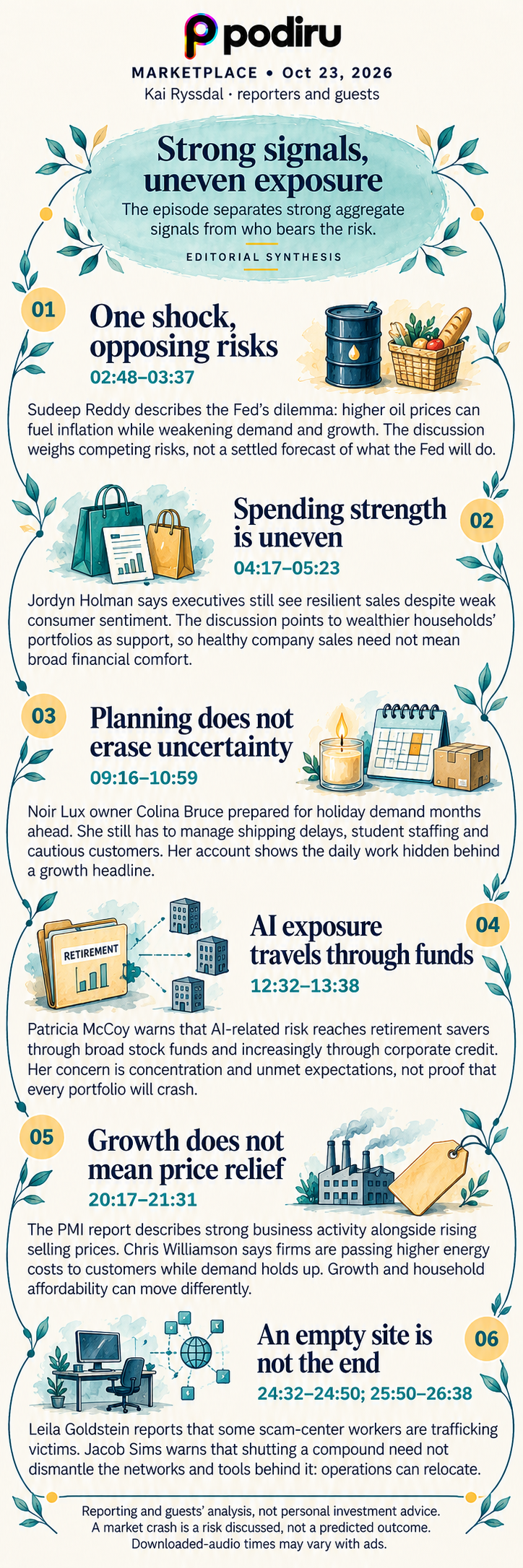
The episode separates strong aggregate signals from who bears the risk.
- 01
One shock, opposing risks
Sudeep Reddy describes the Fed’s dilemma: higher oil prices can fuel inflation while weakening demand and growth. The discussion weighs competing risks, not a settled forecast of what the Fed will do.
Why it matters · our reading A supply shock can complicate monetary policy instead of pointing neatly toward one response.
Keep in mind: Reddy’s scenario analysis, not a verified prediction of war, inflation, recession or a rate decision.
Source passage: 02:48–03:37
- 02
Spending strength is uneven
Jordyn Holman says executives still see resilient sales despite weak consumer sentiment. The discussion points to wealthier households’ portfolios as support, so healthy company sales need not mean broad financial comfort.
Why it matters · our reading Aggregate sales and a typical household’s experience answer different questions.
Keep in mind: The interview does not establish that lower-income households spend nothing, or quantify a universal wealth effect.
Source passage: 04:17–05:23
- 03
Planning does not erase uncertainty
Noir Lux owner Colina Bruce prepared for holiday demand months ahead. She still has to manage shipping delays, student staffing and cautious customers. Her account shows the daily work hidden behind a growth headline.
Why it matters · our reading A concrete shop-level account separates preparation from control over customers, logistics and schedules.
Keep in mind: One owner’s experience, not a representative survey or guaranteed business strategy.
Source passage: 09:16–10:59
- 04
AI exposure travels through funds
Patricia McCoy warns that AI-related risk reaches retirement savers through broad stock funds and increasingly through corporate credit. Her concern is concentration and unmet expectations, not proof that every portfolio will crash.
Why it matters · our reading Indirect ownership can create exposure even when a saver has not deliberately picked an AI stock.
Keep in mind: Holdings and risk vary by fund and investor. Her personal cash reserve is not presented as a recommendation for everyone.
Source passage: 12:32–13:38
- 05
Growth does not mean price relief
The PMI report describes strong business activity alongside rising selling prices. Chris Williamson says firms are passing higher energy costs to customers while demand holds up. Growth and household affordability can move differently.
Why it matters · our reading An economy can expand while the prices households face remain a source of strain.
Keep in mind: PMI is a survey-based early indicator, not a final GDP or consumer-inflation reading. No future rate decision is established.
Source passage: 20:17–21:31
- 06
An empty site is not the end
Leila Goldstein reports that some scam-center workers are trafficking victims. Jacob Sims warns that shutting a compound need not dismantle the networks and tools behind it: operations can relocate.
Why it matters · our reading The report distinguishes a visible enforcement result from the continued capacity to commit fraud, while recognizing a second group of victims.
Keep in mind: The government’s closure claim and Sims’s assessment are attributed. Not every worker is presumed trafficked or guilty, and no unnamed individual is accused.
Source passage: 24:32–24:50; 25:50–26:38
How the ideas connect
1. Weekly Wrap introduces the gap between strong aggregate spending and unequal household resilience. 2. The candle-shop account brings that gap down to day-to-day operational decisions; it is an example, not statistical proof. 3. The AI-retirement interview follows the market discussion by asking who indirectly carries concentrated investment risk. 4. The PMI report returns to the difference between output growth and price relief. 5. Cambodia is a separate investigative strand about fraud, trafficking and portable criminal capacity. Its thematic connection is hidden exposure, not a claim that the earlier US economic forces caused the scams.
Full-episode overview
Kai Ryssdal opens the Weekly Wrap with Sudeep Reddy and Jordyn Holman. Reddy describes the challenge of oil-driven inflation that can also weaken demand, while Holman contrasts gloomy consumer sentiment with company reports of resilient spending. Their discussion emphasizes wealthier households’ financial buffers, questions the durability of AI investment enthusiasm and briefly considers CEOs’ distance from everyday economic experience. These are reported observations and interpretations, not a declared rate or crash forecast.
Colina Bruce of Seattle’s Noir Lux Candle Bar gives the shop-level counterpart: holiday preparation began months earlier, but shipping, student staffing and cautious spending remain hard to plan around. Patricia McCoy then discusses retirement savers’ indirect exposure to AI-related companies through stock indexes and parts of the credit market. She calls for risk management and transparency and uses earlier financial crises as warnings, not proof of a repeat. Her account of keeping a personal cash reserve reflects her own shorter investment horizon; this brief does not turn it into portfolio advice.
After market numbers and sponsors, Mitchell Hartman reports that the October purchasing managers’ survey shows strong activity together with rising selling prices. The survey does not mean that growth is evenly shared or that household affordability has improved. A separate report by Leila Goldstein visits an abandoned Cambodian fraud compound, describes how victims are recruited and defrauded, and explains that some workers are themselves trafficked. It contrasts the government’s closure claim with Jacob Sims’s warning that the networks can continue elsewhere.
The episode ends with a note on announced layoffs, production credits and a Million Bazillion promotion. All those sections and advertisements were reviewed. Exact market levels, sponsor promises, a product-launch claim and the personal cash-buffer amount are not included in the map.
Sources & the fine print
Complete machine-transcript review of the downloaded publisher audio, with targeted retranscription of flagged spans. Not a claimed manual end-to-end audio listen. Interpretations and material caveats are labeled; display times round outward and may shift in differently ad-inserted copies.
- Publisher episode
- Publisher feed
- Weekly Wrap and guest spelling
- Noir Lux founder identity
- Retirement interview
- Patricia McCoy faculty profile
- S&P Global October 23 survey commentary
- Publisher PMI report
- Publisher Cambodia reporting
- INTERPOL on trafficking-fueled scam centres
- Reporting and guests’ analysis, not personal investment advice. A market crash is a risk discussed, not a predicted outcome. Downloaded-audio times may vary with ads.
Chart-informed editorial collection using Apple Podcasts trending episode charts, retrieved October 24, 2026. Not verified annual episode-level listening totals.