

THE CENTRAL IDEA · OUR READING
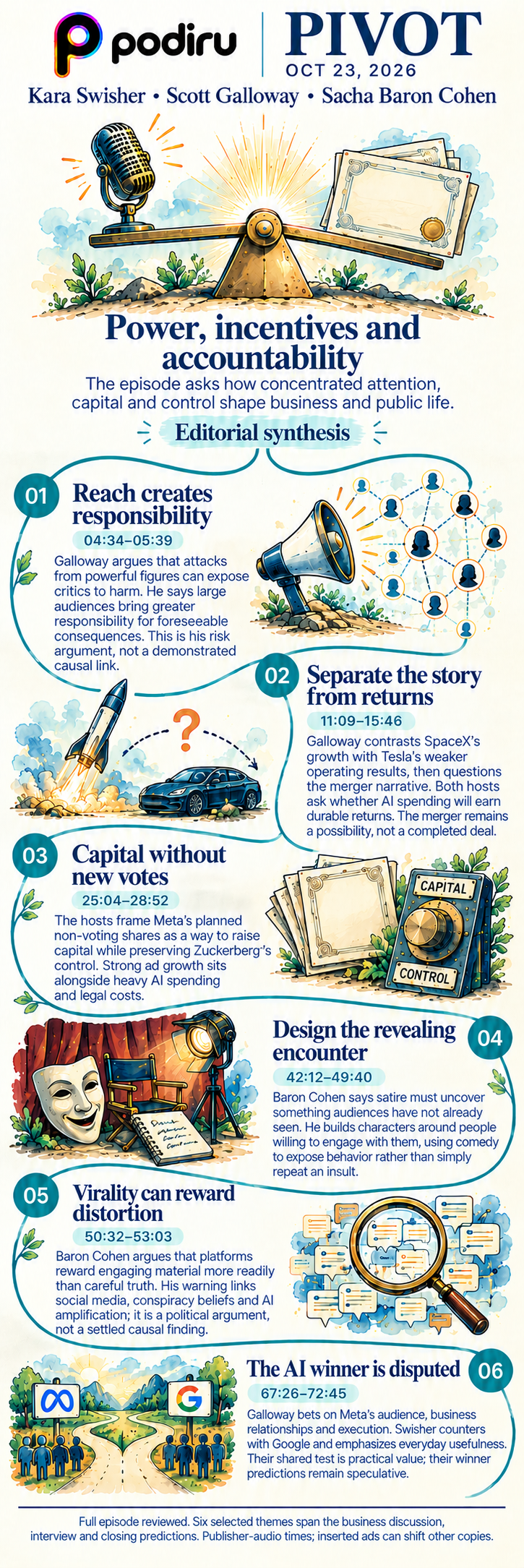
The episode asks how concentrated attention, capital and control shape business and public life.
- 01
Reach creates responsibility
Galloway argues that attacks from powerful figures can expose critics to harm. He says large audiences bring greater responsibility for foreseeable consequences. This is his risk argument, not a demonstrated causal link.
Why it matters · our reading The opening connects concentrated reach to the effects of speech on people who are criticized, rather than treating every speaker as equally powerful.
Keep in mind: This is the hosts’ argument about risk, not proof that a specific post caused violence. Swisher explicitly declines to call the phone calls she received death threats.
Source passage: 04:34–05:39
- 02
Separate the story from returns
Galloway contrasts SpaceX’s growth with Tesla’s weaker operating results, then questions the merger narrative. Both hosts ask whether AI spending will earn durable returns. The merger remains a possibility, not a completed deal.
Why it matters · our reading A persuasive future story can support an expensive valuation or proposed deal before the economics and terms are established. The hosts distinguish operating performance from the price investors pay.
Keep in mind: Galloway’s criticism of the proposed transaction and prediction it will happen are opinions. Tesla’s filing confirms exploration, not approval or completion. No unverified earnings multiple or probability is repeated.
Source passage: 11:09–15:46
- 03
Capital without new votes
The hosts frame Meta’s planned non-voting shares as a way to raise capital while preserving Zuckerberg’s control. Strong ad growth sits alongside heavy AI spending and legal costs.
Why it matters · our reading Financing structure determines who gains economic exposure and who retains decision-making power. The episode connects that governance choice to a costly AI buildout.
Keep in mind: Meta’s release corroborates a planned Class C issuance, with a January 2027 effective date, not shares already issued. The hosts’ claims about personal motives and the proposed California tax remain their interpretation.
Source passage: 25:04–28:52
- 04
Design the revealing encounter
Baron Cohen says satire must uncover something audiences have not already seen. He builds characters around people willing to engage with them, using comedy to expose behavior rather than simply repeat an insult.
Why it matters · our reading The creative method begins with the behavior the filmmaker wants to reveal and then chooses a persona that can elicit it. His account distinguishes a joke’s entertainment value from its satirical purpose.
Keep in mind: This is the filmmaker’s description of his intent and method. Selected, edited encounters are not a representative survey or proof that his films change minds.
Source passage: 42:12–49:40
- 05
Virality can reward distortion
Baron Cohen argues that platforms reward engaging material more readily than careful truth. His warning links social media, conspiracy beliefs and AI amplification; it is a political argument, not a settled causal finding.
Why it matters · our reading He sees an incentive problem: entertaining or inflammatory content travels, while verification can be less compelling. This explains his concern about the interaction of platform design and political persuasion.
Keep in mind: His claim that democracy and social media are incompatible is an opinion. The brief does not validate his anecdote about 2016 ad pricing, attribute a specific violent act to a single post, or endorse fictional characters’ views.
Source passage: 50:32–53:03
- 06
The AI winner is disputed
Galloway bets on Meta’s audience, business relationships and execution. Swisher counters with Google and emphasizes everyday usefulness. Their shared test is practical value; their winner predictions remain speculative.
Why it matters · our reading Existing distribution can make useful AI easier to bring to customers. The disagreement is about which incumbent can turn that advantage into durable use and business results.
Keep in mind: This is a forecast, not investment advice or an established winner. Download counts do not prove continuing use, and the episode itself questions whether Muse will become a habit.
Source passage: 67:26–72:45
How the ideas connect
The hosts move from influence over audiences to influence over investor expectations. The discussion compares the economics of a proposed combination with who retains corporate control. Meta’s business effectiveness and the guest’s criticism of platform incentives are distinct perspectives on the same industry. Baron Cohen presents his films as an attempt to expose the behavior and beliefs he worries platforms amplify. The ending revisits the commercial strength of large audiences without resolving the earlier social criticisms.
Full-episode overview
Kara Swisher and Scott Galloway open by discussing Musk’s response to Swisher’s reporting and the responsibilities of public figures with large audiences. They raise concerns about retaliation and gendered hostility. Those are their assessments; Swisher specifically says she would not describe the troubling calls she received as death threats.
The business discussion separates SpaceX’s strong reported growth from Tesla’s weaker operating performance, then questions the valuation and governance logic of a possible combination. The hosts also discuss the business consequences they foresee from political disputes over Starlink and ask whether heavy AI capital spending will produce sustained returns. Their merger and regulatory predictions are not completed events.
Meta provides a contrasting case: they praise the effectiveness of its core products and advertising business while criticizing concentrated control, legal exposure and the cost of its AI buildout. They discuss planned non-voting stock and Joel Kaplan’s announced departure, offering competing interpretations of the political strategy. Primary company material confirms the non-voting share plan and strong ad growth; it does not establish the hosts’ claims about personal motives.
Sacha Baron Cohen joins to discuss Ali G: Who Iz I?, creating characters that reveal people’s behavior, and adapting satire when everyday politics is already outrageous. He says he feels fear despite being able to perform through it, describes his career’s uncertain start, and explains his wish to combine laughter with greater tolerance. He argues that social platforms and AI can magnify conspiracies and hatred. His account of satire’s purpose and political effects is preserved as his perspective, not evidence of a measured effect on an audience.
After a brief discussion of reported Character.AI bankruptcy and Disney arrangements, the closing predictions diverge: Galloway favors Meta as the eventual AI winner; Swisher favors Google and practical utility, with Apple also discussed. The hosts agree that existing distribution and usefulness matter, without resolving who will succeed. Sponsor reads, promotions, film excerpts, banter and credits were reviewed but are not treated as editorial evidence.
Sources & the fine print
Complete machine-transcript review of the downloaded publisher audio, with targeted retranscription of flagged spans. Not a claimed manual end-to-end audio listen. Interpretations and material caveats are labeled; display times round outward and may shift in differently ad-inserted copies.
Full episode reviewed. Six selected themes span the business discussion, interview and closing predictions. Publisher-audio times; inserted ads can shift other copies. Full original timestamped transcript reviewed, including sponsor messages and closing credits. This is not a claim of manual end-to-end listening. The hosts’ Tesla net-income percentage was not used because it does not match the checked comparable company figures.
- Full episode reviewed. Six selected themes span the business discussion, interview and closing predictions. Publisher-audio times; inserted ads can shift other copies.
Chart-informed editorial collection using Apple Podcasts trending episode charts, retrieved October 24, 2026. Not verified annual episode-level listening totals.