

THE CENTRAL IDEA · OUR READING
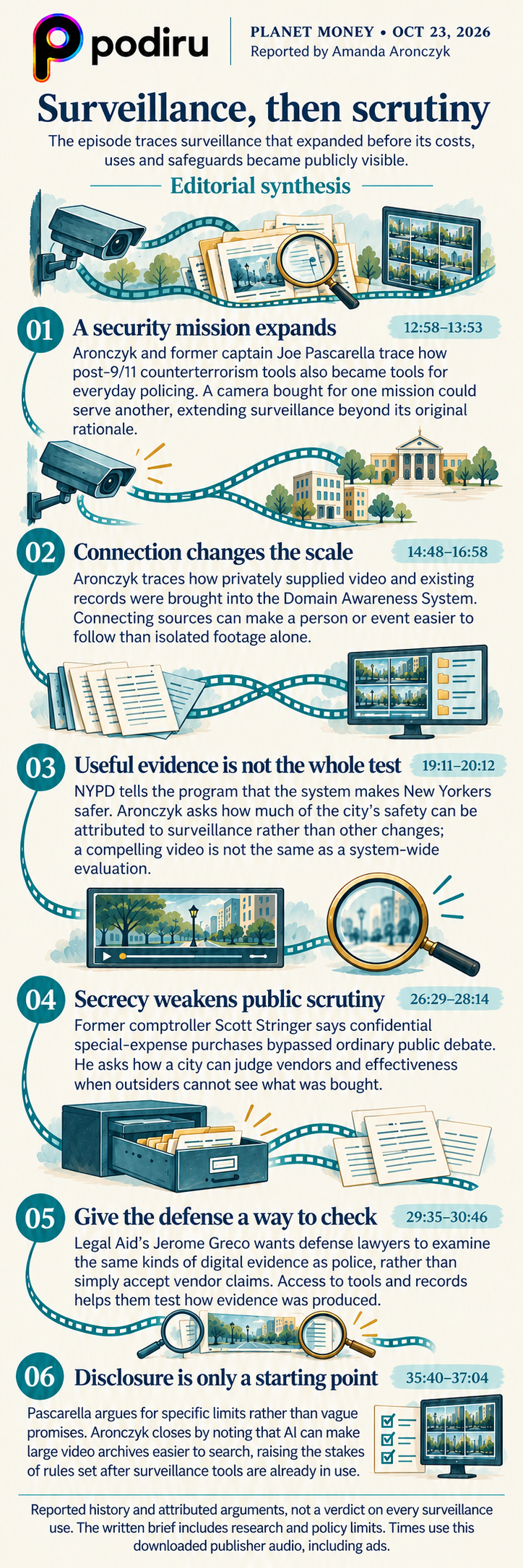
The episode traces surveillance that expanded before its costs, uses and safeguards became publicly visible.
- 01
A security mission expands
Aronczyk and former captain Joe Pascarella trace how post-9/11 counterterrorism tools also became tools for everyday policing. A camera bought for one mission could serve another, extending surveillance beyond its original rationale.
Why it matters · our reading Once equipment and funding are in place, additional uses can appear inexpensive. The decision to buy a tool and the decision to expand its purpose are therefore different accountability questions.
Keep in mind: This history does not establish that every new use was illegal or ineffective. Pascarella’s early hope that cameras could reduce physical stops is not proof that they did.
Source passage: 12:58–13:53
- 02
Connection changes the scale
Aronczyk traces how privately supplied video and existing records were brought into the Domain Awareness System. Connecting sources can make a person or event easier to follow than isolated footage alone.
Why it matters · our reading The change is not just more cameras. A searchable combination of video, locations and records reduces the effort needed to reconstruct movements or investigate an event.
Keep in mind: Camera registration and live-feed sharing are different arrangements. NYPD policy limits access by role and purpose; the story does not establish unrestricted access to every feed for every officer.
Source passage: 14:48–16:58
- 03
Useful evidence is not the whole test
NYPD tells the program that the system makes New Yorkers safer. Aronczyk asks how much of the city’s safety can be attributed to surveillance rather than other changes; a compelling video is not the same as a system-wide evaluation.
Why it matters · our reading Showing that a tool helps an investigation differs from measuring its overall effects, costs and trade-offs. Those questions need evidence about how and where the tool is used.
Keep in mind: The cited CCTV research does find a modest average crime reduction, with effects varying by setting and monitoring. It does not isolate the causal effect of New York’s entire combined system.
Source passage: 19:11–20:12
- 04
Secrecy weakens public scrutiny
Former comptroller Scott Stringer says confidential special-expense purchases bypassed ordinary public debate. He asks how a city can judge vendors and effectiveness when outsiders cannot see what was bought.
Why it matters · our reading Procurement transparency makes costs, claims and alternatives available for challenge before a technology becomes routine. Security arguments can otherwise narrow who gets to ask those questions.
Keep in mind: Confidential procurement is not the same as no internal review. The court required records production; it did not rule that every underlying surveillance purchase or use was unlawful.
Source passage: 26:29–28:14
- 05
Give the defense a way to check
Legal Aid’s Jerome Greco wants defense lawyers to examine the same kinds of digital evidence as police, rather than simply accept vendor claims. Access to tools and records helps them test how evidence was produced.
Why it matters · our reading A technological advantage can become an evidentiary advantage if only one side can inspect the method. Independent analysis creates a way to question accuracy rather than assume it.
Keep in mind: Owning the same tool does not guarantee a reliable result or resolve a legal challenge. Greco’s account describes defense work; it does not establish misconduct in every case mentioned.
Source passage: 29:35–30:46
- 06
Disclosure is only a starting point
Pascarella argues for specific limits rather than vague promises. Aronczyk closes by noting that AI can make large video archives easier to search, raising the stakes of rules set after surveillance tools are already in use.
Why it matters · our reading Public disclosure can make debate possible, but usable safeguards also require clear purposes, access limits, retention rules and accountability for compliance.
Keep in mind: The episode’s retention example is hypothetical, not a universal legal deadline. Existing laws and NYPD policies do impose limits; the brief does not claim surveillance operates outside all rules.
Source passage: 35:40–37:04
How the ideas connect
An expanded mission and connected data help explain how the surveillance capability grew. Greater capacity raises, but does not answer, the question of measurable public benefit. Public evaluation requires knowing what was bought, promised and paid for. Records access and technical access support different forms of scrutiny. Testing individual evidence and setting prospective safeguards are complementary accountability tasks.
Full-episode overview
Amanda Aronczyk starts with the scale of video evidence she encountered during grand-jury service. She and civil-rights lawyer Michelle Dahl, who had served nearby, do not disclose specific cases; the opening reconstruction is illustrative. Dahl explains why combining records and footage can feel different from seeing individual cameras on a street. The story asks how the system expanded and why its procurement was often difficult for the public to examine. It does not determine guilt in any criminal case.
Former NYPD captain Joseph “Joe” Pascarella recalls an earlier period of policing with fewer digital tools and his hope that cameras could offer a less physical alternative to stops. He also describes a shift after 9/11 toward local counterterrorism, supported by federal resources and private funding. Aronczyk traces the expansion into ordinary policing, the integration of databases and the use of privately supplied camera feeds. The Domain Awareness System, developed with Microsoft and publicly launched in 2012, combined existing sources. NPR discloses Microsoft’s sponsorship during that discussion. Historical scale figures in archival audio are not presented here as current inventories.
NYPD says the system improves safety. The episode also asks whether New York’s safety outcomes can be separated from economic, demographic and policing changes. The cited CCTV meta-analysis needs careful framing: its authors report a modest overall crime reduction, with variation by setting, active monitoring and accompanying interventions, rather than a universal absence of benefit. That research does not independently measure the full current DAS system. The brief therefore distinguishes help in individual investigations from proof of aggregate effectiveness.
Dahl’s surveillance tour and the host’s questions bring out both the reach of the system and the department’s stated restrictions. NYPD tells the program that not every officer can view video on a phone and that access must serve legitimate law-enforcement purposes. The department’s current published policy also describes role-based access, logs and audits. The brief does not turn the episode’s shorthand about warrants into a blanket legal claim: rules for querying a system are not automatically the rules for collecting every underlying type of information. Dahl’s constitutional objections and her organization’s challenge remain attributed allegations, not a court verdict on the entire platform.
The second half examines the special-expense procurement arrangement. Former comptroller Scott Stringer explains the security justification and why he later objected to the loss of ordinary public debate. Greco describes learning about surveillance tools through defense cases, buying forensic tools to independently examine evidence and questioning vendor claims. NPR includes the department’s statement that it now has a strict procurement and vendor-review process. Neither a vendor’s police background nor a confidential contract by itself proves misconduct.
The episode follows the POST Act’s passage in 2020, Stringer’s withdrawal from the special-expense arrangement and Legal Aid’s continuing fight for older records. The official appellate opinion corroborates the confidential procurement framework and its termination, and affirms rolling production of records under FOIL. That is a records-access ruling, not a finding that every surveillance use was unconstitutional. Partial releases described in the episode and Legal Aid’s repository do not establish a complete current inventory or final total of spending. The close calls for more specific safeguards as AI lowers the effort needed to search footage. Pascarella’s proposed retention limit is an example, not a statement of the applicable deadline for every dataset. Sponsor messages, credits and post-roll promotions were also reviewed.
Scope of oversight: Ending the special-expense procurement mechanism in 2020 did not turn off surveillance systems or make all older records immediately public. The current POST framework requires technology-specific policies, advance publication and comment, and reporting and inspector access; it does not require general Council approval of every use. A published policy is evidence of stated rules, not proof of compliance in every instance. NYPD’s current policy also distinguishes DAS as an aggregator from separate facial-recognition analysis, for which an image may be exported.
Sources & the fine print
Complete machine-transcript review of the downloaded publisher audio, with targeted retranscription of flagged spans. Not a claimed manual end-to-end audio listen. Interpretations and material caveats are labeled; display times round outward and may shift in differently ad-inserted copies.
Entire downloaded publisher audio processed and ASR reviewed, with targeted rechecks and primary corroboration. Original paraphrase, no transcript redistribution. This is an editorial episode summary, not legal advice.
- NPR episode page and publisher audio identity
- Publisher feed
- Microsoft’s 2012 DAS announcement: primary historical source, not independent efficacy evaluation
- NYPD POST Act disclosure hub
- NYPD DAS impact and use policy, updated February 4, 2026
- Official February 6, 2025 appellate opinion on SPEX records production
- Legal Aid’s SPEX records repository: litigant account, dated releases and linked court documents
- Legal Aid Digital Forensics Unit: scope of defense evidence analysis
- Piza and colleagues’ CCTV review: author summary of peer-reviewed 2019 meta-analysis
- Current NYC Administrative Code §14-188: technology policies, public comment and reporting, including amendments
- Reported history and attributed arguments, not a verdict on every surveillance use. The written brief includes research and policy limits. Times use this downloaded publisher audio, including ads.
Chart-informed editorial collection using Apple Podcasts trending episode charts, retrieved October 24, 2026. Not verified annual episode-level listening totals.