

THE CENTRAL IDEA · OUR READING
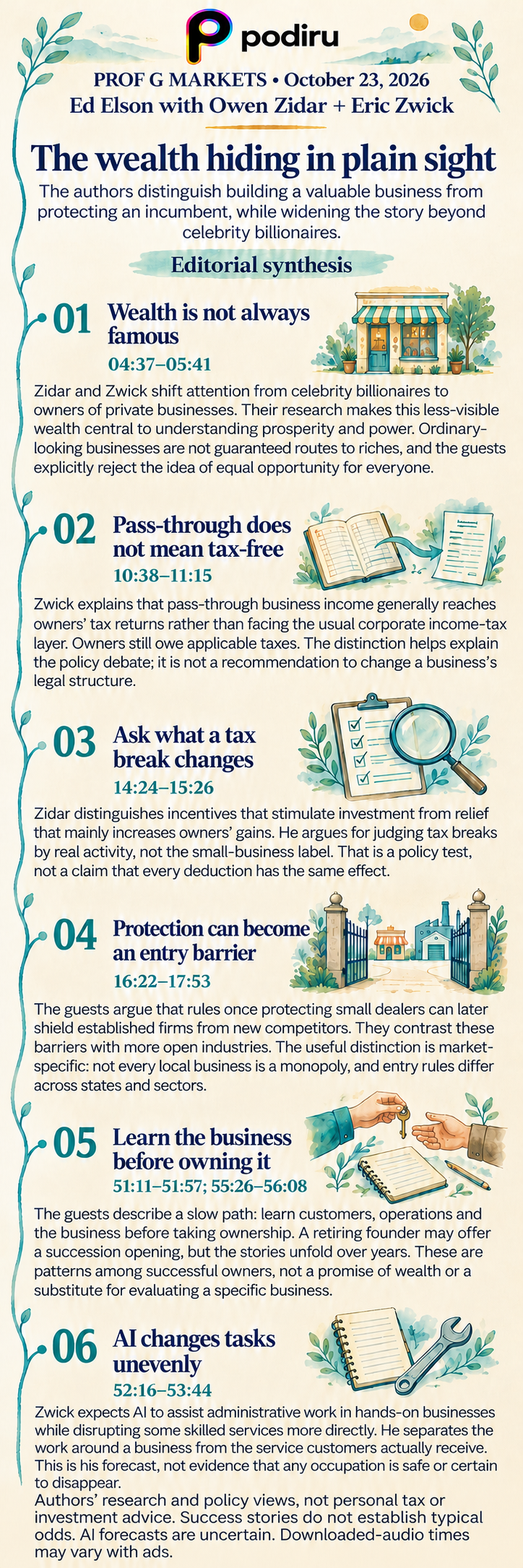
The authors distinguish building a valuable business from protecting an incumbent, while widening the story beyond celebrity billionaires.
- 01
Wealth is not always famous
Zidar and Zwick shift attention from celebrity billionaires to owners of private businesses. Their research makes this less-visible wealth central to understanding prosperity and power. Ordinary-looking businesses are not guaranteed routes to riches, and the guests explicitly reject the idea of equal opportunity for everyone.
Why it matters · our reading Looking beyond public-company celebrities changes which businesses and policy interests become visible.
Keep in mind: The map does not reproduce unverified book-specific wealth totals or treat a selected set of successful owners as representative of all businesses.
Source passage: 04:37–05:41; 06:52–08:26
- 02
Pass-through does not mean tax-free
Zwick explains that pass-through business income generally reaches owners’ tax returns rather than facing the usual corporate income-tax layer. Owners still owe applicable taxes. The distinction helps explain the policy debate; it is not a recommendation to change a business’s legal structure.
Why it matters · our reading Separating the location of taxation from the existence of taxation prevents a basic misunderstanding of pass-through status.
Keep in mind: Rules vary by entity, income and circumstances. S-corporation treatment is an authoritative example, not a complete guide to every pass-through form.
Source passage: 10:38–11:15
- 03
Ask what a tax break changes
Zidar distinguishes incentives that stimulate investment from relief that mainly increases owners’ gains. He argues for judging tax breaks by real activity, not the small-business label. That is a policy test, not a claim that every deduction has the same effect.
Why it matters · our reading A benefit to an owner and an increase in hiring or investment are different outcomes and require different evidence.
Keep in mind: Research on the original Section 199A deduction concerns specified historical exposure and outcomes, not definitive proof of every effect of the 2025 extension.
Source passage: 14:24–15:26
- 04
Protection can become an entry barrier
The guests argue that rules once protecting small dealers can later shield established firms from new competitors. They contrast these barriers with more open industries. The useful distinction is market-specific: not every local business is a monopoly, and entry rules differ across states and sectors.
Why it matters · our reading A policy’s original beneficiary and its present competitive effects need not remain the same as firms and markets evolve.
Keep in mind: The causal interpretation belongs to the guests. State restrictions are not uniform; protections can have other objectives, and no individual firm is adjudged to have acted illegally.
Source passage: 16:22–17:53; 23:24–25:13
- 05
Learn the business before owning it
The guests describe a slow path: learn customers, operations and the business before taking ownership. A retiring founder may offer a succession opening, but the stories unfold over years. These are patterns among successful owners, not a promise of wealth or a substitute for evaluating a specific business.
Why it matters · our reading Operating knowledge and succession relationships are different assets from a fashionable startup idea or a get-rich-quick pitch.
Keep in mind: The interview does not establish a typical success rate, purchase price, financing feasibility or suitability for a particular person.
Source passage: 51:11–51:57; 55:26–56:08
- 06
AI changes tasks unevenly
Zwick expects AI to assist administrative work in hands-on businesses while disrupting some skilled services more directly. He separates the work around a business from the service customers actually receive. This is his forecast, not evidence that any occupation is safe or certain to disappear.
Why it matters · our reading Task-level exposure can differ within and across industries, so one sweeping entrepreneurship forecast misses important distinctions.
Keep in mind: Future capability, adoption and competitive effects are uncertain. No tool’s legal, financial or professional reliability is endorsed.
Source passage: 52:16–53:44
How the ideas connect
The data story broadens who counts as wealthy. The tax explanation distinguishes organizational form from tax exemption. The policy chapters then separate productive enterprise from benefits or rules that may protect incumbents. The career discussion returns to entry: knowledge, time, succession and changing tasks. These connections are an editorial reading, not proof that one mechanism explains every fortune.
Full-episode overview
Ed Elson interviews economists Owen Zidar and Eric Zwick about The Everywhere Millionaire. They explain how linking anonymized business and owner tax records led them to study substantial private-business wealth outside the celebrity-billionaire narrative. Founder stories illustrate their argument that practical, unglamorous enterprises can generate large fortunes, while the guests explicitly reject equal opportunity as a description of the whole economy. Their specific wealth counts and success anecdotes are not used as general odds of becoming rich.
The central policy discussion distinguishes pass-through taxation from corporate taxation, then asks whether tax preferences stimulate investment or mainly reward existing owners. The guests argue that some state and local rules protect incumbents and that wealthy business owners can influence the policies affecting them. They favor evaluating tax incentives, reducing unjustified entry barriers and broadening political representation. These are attributed research interpretations and policy preferences, not findings that every owner, elected official or licensing rule behaves alike. The brief does not reproduce disputed or unverified tax thresholds, fiscal totals, political-representation percentages or blanket commission-rate claims.
The final section turns to entrepreneurship: accumulated operating experience, possible succession from retiring founders, uncertain AI effects, and private equity as both an exit option and a potential source of openings for competitors. Anecdotes about service quality are not treated as proof of a universal private-equity effect. The guests end with conditional optimism about opportunity and the need to address barriers. All advertising, promotions and production credits were also reviewed and excluded from the substantive map. Targeted checks additionally recovered a brief opening montage of disconnected market sound bites and closing music after the credits; neither is treated as interview evidence.
Sources & the fine print
Complete machine-transcript review of the downloaded publisher audio, with targeted retranscription of flagged spans. Not a claimed manual end-to-end audio listen. Interpretations and material caveats are labeled; display times round outward and may shift in differently ad-inserted copies.
- Publisher episode page
- Publisher RSS
- Authors’ book site
- Primary research: Capitalists in the Twenty-First Century (2019)
- IRS: S corporation stock and debt basis
- IRS: qualified business income deduction
- Primary research: How Do Business Owners Respond to a Tax Cut?
- FTC staff: direct-to-consumer auto sales (2015)
- Texas DMV: distributor licensing
- Authors’ research and policy views, not personal tax or investment advice. Success stories do not establish typical odds. AI forecasts are uncertain. Downloaded-audio times may vary with ads.
Chart-informed editorial collection using Apple Podcasts trending episode charts, retrieved October 24, 2026. Not verified annual episode-level listening totals.