

THE CENTRAL IDEA · OUR READING
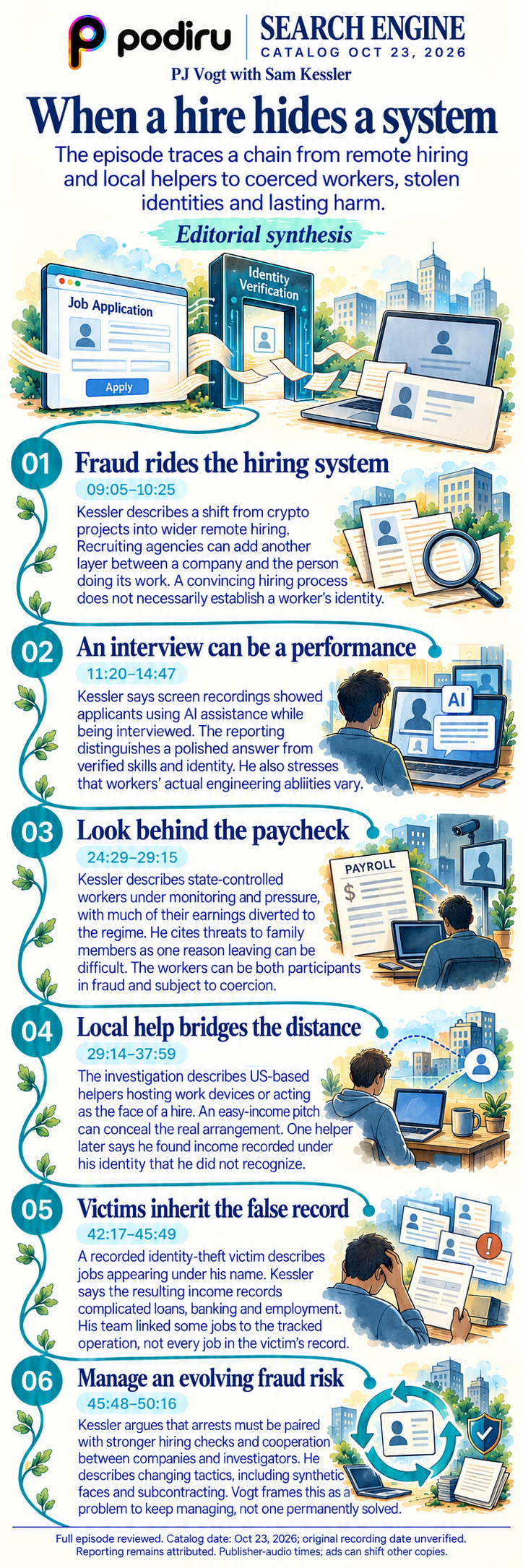
The episode traces a chain from remote hiring and local helpers to coerced workers, stolen identities and lasting harm.
- 01
Fraud rides the hiring system
Kessler describes a shift from crypto projects into wider remote hiring. Recruiting agencies can add another layer between a company and the person doing its work. A convincing hiring process does not necessarily establish a worker’s identity.
Why it matters · our reading The reported weakness is in how identity and work are verified across a chain of employers and intermediaries, not simply whether an applicant can write code.
Keep in mind: This is not an estimate of how many companies are affected. A remote role, nationality or accent alone is not evidence of fraud.
Source passage: 09:05–10:25
- 02
An interview can be a performance
Kessler says screen recordings showed applicants using AI assistance while being interviewed. The reporting distinguishes a polished answer from verified skills and identity. He also stresses that workers’ actual engineering abilities vary.
Why it matters · our reading The same interview can appear credible to a recruiter while concealing outside assistance or a false identity. This complicates reliance on presentation alone.
Keep in mind: The episode’s improvised insult test is not a validated screening method. Neither AI use nor imperfect English proves misconduct.
Source passage: 11:20–14:47
- 03
Look behind the paycheck
Kessler describes state-controlled workers under monitoring and pressure, with much of their earnings diverted to the regime. He cites threats to family members as one reason leaving can be difficult. The workers can be both participants in fraud and subject to coercion.
Why it matters · our reading Following the money also reveals power over the people earning it. The discussion separates the state’s incentives from the workers’ freedom to choose.
Keep in mind: Conditions vary, and access to this system is limited. Government and human-rights evidence supports broader coercion patterns, not every individual’s circumstances.
Source passage: 24:29–29:15
- 04
Local help bridges the distance
The investigation describes US-based helpers hosting work devices or acting as the face of a hire. An easy-income pitch can conceal the real arrangement. One helper later says he found income recorded under his identity that he did not recognize.
Why it matters · our reading Local infrastructure and borrowed identities can make an overseas operation appear domestic. The story also shows that a helper can become an identity-theft victim.
Keep in mind: People’s knowledge and involvement differ. The interview is not a court judgment about the featured helper, and no conviction is asserted.
Source passage: 29:14–37:59
- 05
Victims inherit the false record
A recorded identity-theft victim describes jobs appearing under his name. Kessler says the resulting income records complicated loans, banking and employment. His team linked some jobs to the tracked operation, not every job in the victim’s record.
Why it matters · our reading The harm does not end at a fraudulent hire: the person whose identity was used can face a long effort to correct systems that now mistrust them.
Keep in mind: These are the victim’s and reporter’s accounts. The brief does not expose personal identifiers or generalize the experience to every victim.
Source passage: 42:17–45:49
- 06
Manage an evolving fraud risk
Kessler argues that arrests must be paired with stronger hiring checks and cooperation between companies and investigators. He describes changing tactics, including synthetic faces and subcontracting. Vogt frames this as a problem to keep managing, not one permanently solved.
Why it matters · our reading A changing operation can route around a single test. Ongoing, layered verification is more consistent with the discussion than a one-time trick.
Keep in mind: Future deepfake detectability is a forecast, not an established endpoint. Current FBI guidance also warns that aggressive filters can wrongly exclude legitimate applicants.
Source passage: 45:48–50:16
How the ideas connect
The hiring chain creates opportunities for a false identity to survive a persuasive interview. The story turns from how applicants appear to the pressures under which the reported workers operate. State-directed work still depends on local infrastructure and people outside the country. Borrowed or stolen identities shift consequences onto people who may not have received the wages. Persistent harm and changing tactics motivate an ongoing prevention-and-enforcement response.
Full-episode overview
PJ Vogt asks how a covert North Korean IT-worker operation has navigated a remote labor market that many legitimate applicants find confusing. Wall Street Journal reporter Sam Kessler recounts how an initial crypto-industry tip grew into an investigation with Emma Scott and Robert McMillan. Screen recordings and related computer data gave the team a view of applications, interviews and work. The episode uses excerpts from their documentary; the existence of those excerpts is not an independent review of all underlying evidence.
Kessler describes expansion beyond crypto into ordinary remote hiring, sometimes through staffing intermediaries. He says AI assistance helped applicants perform during interviews and that newer identity disguises are becoming more sophisticated. The hosts discuss improvised screening questions, including a demand to insult North Korea’s leader. This brief does not endorse that as a reliable or appropriate test. Kessler explicitly says actual technical ability varies: a plausible or capable worker can still be misrepresenting identity, while poor communication alone proves nothing.
The conversation then turns to worker conditions and where earnings go. Kessler relies on defectors, experts and government reporting to describe monitoring, diverted wages and threats to families. These are state-controlled operations, not a claim about all North Korean people or remote workers. Broader government reporting supports the existence of coercive overseas-labor practices; it does not establish the personal circumstances of every worker shown. The episode offers a large annual revenue estimate but acknowledges uncertainty. The brief omits an exact total because current official estimates use differing periods and ranges.
Local facilitators are a crucial link in the account: they can receive devices, provide a domestic presence or appear in interviews while someone else performs the work. The featured US helper describes the appeal of easy income, later doubts about the arrangement and unexpected income associated with his identity. Kessler distinguishes different degrees of knowledge and participation. The brief does not infer a conviction, decide this person’s legal culpability or reproduce detailed operational instructions.
A recorded victim describes discovering employment records in his name for jobs he had not held. Kessler explains the burden this placed on banking, borrowing and finding work, and explicitly limits how many of those jobs his team could connect to the tracked operation. The closing discussion argues that enforcement alone will not end an adaptive system. Kessler calls for better vetting and information-sharing alongside law enforcement; Vogt sees a risk that must be continually managed. Predictions about undetectable deepfakes remain predictions. The complete audio, including the opening invitation, advertisements, documentary excerpts, outro, credits and closing sponsor, was reviewed through full timestamped ASR and targeted rechecks.
Sources & the fine print
Complete machine-transcript review of the downloaded publisher audio, with targeted retranscription of flagged spans. Not a claimed manual end-to-end audio listen. Interpretations and material caveats are labeled; display times round outward and may shift in differently ad-inserted copies.
The podcast’s catalog date is October 23, 2026, but the media filename contains April 14, 2026. Neither that filename nor October advertisements establish when the interview was recorded. No explicit re-release framing was found. Treat this as a catalog selection, not a claim of newly recorded reporting. Reviewed the complete 54:35.102 downloaded audio through full timestamped ASR and targeted rechecks. Not a claimed manual end-to-end listen. Documentary excerpts are part of the podcast; the full documentary was not separately reviewed. Official sources corroborate the broader mechanisms, not every personal account. Times include inserted ads. Current FBI guidance supports layered checks and explicitly cautions against single indicators or controls that exclude legitimate applicants. Nationality and accent are not findings of fraud. No personal identifiers are reproduced. Selection: current Apple US chart-backed batch, not a verified annual most-listened ranking.
- Publisher episode
- Publisher feed
- Linked WSJ investigation
- Linked documentary
- FBI advisory
- Government threat statement
- Government overseas-labor statement
- Full episode reviewed. Catalog date: Oct 23, 2026; original recording date unverified. Reporting remains attributed. Publisher-audio times; ads can shift other copies.
Chart-informed editorial collection using Apple Podcasts trending episode charts, retrieved October 24, 2026. Not verified annual episode-level listening totals.