

THE CENTRAL IDEA · OUR READING
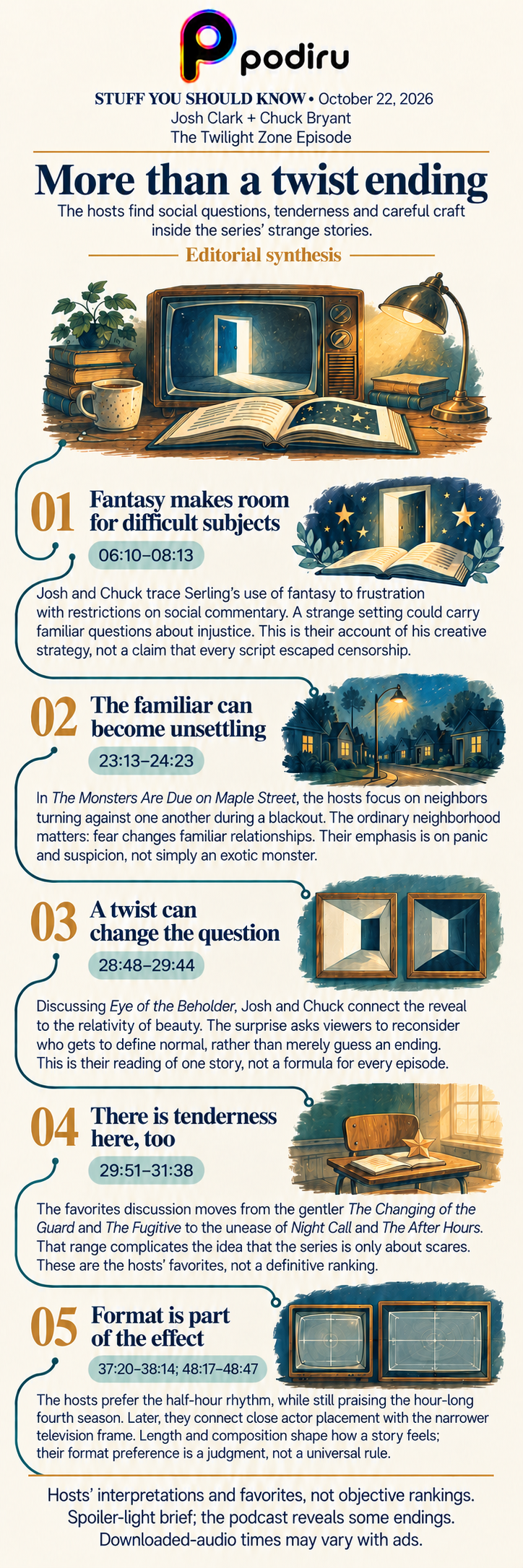
The hosts find social questions, tenderness and careful craft inside the series’ strange stories.
- 01
Fantasy makes room for difficult subjects
Josh and Chuck trace Serling’s use of fantasy to frustration with restrictions on social commentary. A strange setting could carry familiar questions about injustice. This is their account of his creative strategy, not a claim that every script escaped censorship.
Why it matters · our reading An imagined situation can make a difficult social subject tellable without removing its human stakes.
Keep in mind: The historical account is selective. Serling’s later interview also says contemporary drama can address problems more directly; fantasy is not inherently the superior form.
Source passage: 06:10–08:13
- 02
The familiar can become unsettling
In The Monsters Are Due on Maple Street, the hosts focus on neighbors turning against one another during a blackout. The ordinary neighborhood matters: fear changes familiar relationships. Their emphasis is on panic and suspicion, not simply an exotic monster.
Why it matters · our reading Locating the disturbance within everyday social relationships makes the story’s threat recognizable rather than safely distant.
Keep in mind: This is interpretation of a fictional story, not a general psychological claim or a reconstruction of a real event. The final reveal is not retold.
Source passage: 23:13–24:23
- 03
A twist can change the question
Discussing Eye of the Beholder, Josh and Chuck connect the reveal to the relativity of beauty. The surprise asks viewers to reconsider who gets to define normal, rather than merely guess an ending. This is their reading of one story, not a formula for every episode.
Why it matters · our reading A reversal can challenge the viewer’s starting assumptions instead of serving only as an unexpected event.
Keep in mind: The brief discusses the premise and theme without reproducing the visual reveal or treating any appearance as objectively normal.
Source passage: 28:48–29:44
- 04
There is tenderness here, too
The favorites discussion moves from the gentler The Changing of the Guard and The Fugitive to the unease of Night Call and The After Hours. That range complicates the idea that the series is only about scares. These are the hosts’ favorites, not a definitive ranking.
Why it matters · our reading Affection, sacrifice, loneliness and uncertainty give the anthology more than one emotional register.
Keep in mind: Preferences are subjective. The map does not reproduce the endings or promise that every viewer will find the same episodes comforting or frightening.
Source passage: 29:51–31:38
- 05
Format is part of the effect
The hosts prefer the half-hour rhythm, while still praising the hour-long fourth season. Later, they connect close actor placement with the narrower television frame. Length and composition shape how a story feels; their format preference is a judgment, not a universal rule.
Why it matters · our reading The viewing experience depends on pacing and what the frame can contain, not only on a synopsis or twist.
Keep in mind: The original series used hour-long episodes in season four and returned to half-hours in season five. The framing discussion is the hosts’ production explanation, not a shot-by-shot analysis.
Source passage: 37:20–38:14; 48:17–48:47
How the ideas connect
The creative-history section explains why the hosts connect fantasy with social commentary. The episode examples then show different uses of that approach: familiar relationships become unstable, assumptions are reversed, and tenderness sits beside fear. The format discussion adds pacing and visual composition to the account. This is an editorial reading of the conversation, not a claim that every story follows one design.
Full-episode overview
Josh Clark and Chuck Bryant discuss The Twilight Zone as enthusiastic viewers and explain why Rod Serling’s anthology remains more than a collection of surprise endings. They begin with his live-television writing and struggles over social commentary, then describe the series’ development, his narration and on-camera presence, and the themes they notice: loneliness, nostalgia, war, panic and mob behavior. Their connection between biography and fiction is an interpretation; the brief does not diagnose Serling or claim one experience caused a particular script.
The hosts revisit individual episodes, sometimes avoiding endings and sometimes revealing them. They discuss Time Enough at Last, A Stop at Willoughby, A Quality of Mercy, The Monsters Are Due on Maple Street and Eye of the Beholder, then contrast gentler favorites with more frightening ones. They also praise directors, cinematography and actors, explain the theme’s assembly from library music, and discuss later adaptations and Simpsons echoes. This brief is spoiler-light, not a scene-by-scene retelling; the podcast itself contains major spoilers and deliberately bleeps one reveal.
The later discussion covers the original series’ changing length, Serling’s other work, television revivals and the 1983 film. The film’s fatal production accident is acknowledged without repeating the episode’s inaccurate or uncertain mechanism, victim description, or claims about its commercial effect. The hosts compare later versions with Black Mirror; their explanation of competition and their favorites are not verified causes or objective rankings. They finish with a production observation about actors sharing a narrow television frame. The unrelated listener-mail food-contamination anecdote, advertisements, promotions and credits were all reviewed and are not recommendations.
Sources & the fine print
Complete machine-transcript review of the downloaded publisher audio, with targeted retranscription of flagged spans. Not a claimed manual end-to-end audio listen. Interpretations and material caveats are labeled; display times round outward and may shift in differently ad-inserted copies.
- Publisher episode page
- iHeart show and episode listing
- Rod Serling Archive: original series
- Television Academy: Rod Serling
- Rod Serling’s final interview, Memorial Foundation transcript
- Paramount+: original season-three episode guide
- Paramount+: The Eye of the Beholder
- NTSB: completed 1982 helicopter-accident investigation
- Hosts’ interpretations and favorites, not objective rankings. Spoiler-light brief; the podcast reveals some endings. Downloaded-audio times may vary with ads.
Chart-informed editorial collection using Apple Podcasts trending episode charts, retrieved October 24, 2026. Not verified annual episode-level listening totals.