

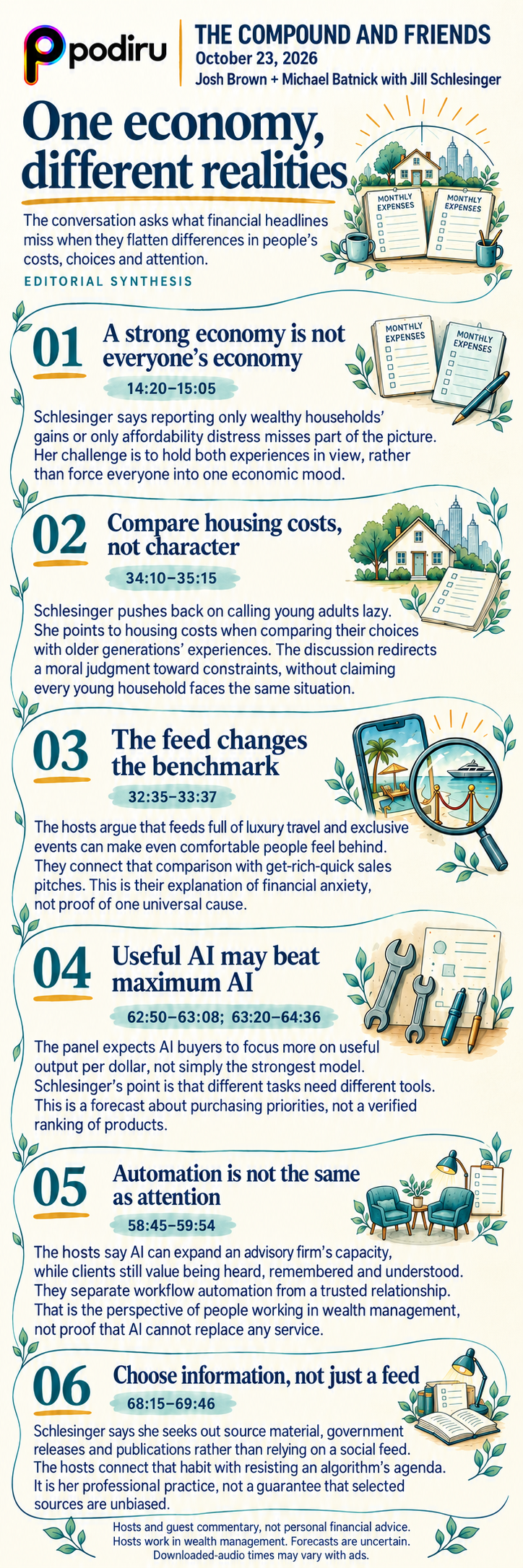
THE CENTRAL IDEA · OUR READING
The conversation asks what financial headlines miss when they flatten differences in people’s costs, choices and attention.
- 01
A strong economy is not everyone’s economy
Schlesinger says reporting only wealthy households’ gains or only affordability distress misses part of the picture. Her challenge is to hold both experiences in view, rather than force everyone into one economic mood.
Why it matters · our reading Aggregate performance and personal exposure answer different questions; the guest argues that reporting should keep both visible.
Keep in mind: This is Schlesinger’s assessment of reporting and household experience, not a new population estimate.
Source passage: 14:20–15:05
- 02
Compare housing costs, not character
Schlesinger pushes back on calling young adults lazy. She points to housing costs when comparing their choices with older generations’ experiences. The discussion redirects a moral judgment toward constraints, without claiming every young household faces the same situation.
Why it matters · our reading A cost-based comparison can reveal obstacles that a generational stereotype conceals.
Keep in mind: The map retains the attributed argument, not the unverified claim that inflation-adjusted starting incomes are unchanged.
Source passage: 34:10–35:15
- 03
The feed changes the benchmark
The hosts argue that feeds full of luxury travel and exclusive events can make even comfortable people feel behind. They connect that comparison with get-rich-quick sales pitches. This is their explanation of financial anxiety, not proof of one universal cause.
Why it matters · our reading An exceptional lifestyle presented as normal can become a misleading reference point for one’s own finances.
Keep in mind: The discussion’s causal account is commentary. It does not establish individual exposure, prevalence or psychological effects.
Source passage: 32:35–33:37
- 04
Useful AI may beat maximum AI
The panel expects AI buyers to focus more on useful output per dollar, not simply the strongest model. Schlesinger’s point is that different tasks need different tools. This is a forecast about purchasing priorities, not a verified ranking of products.
Why it matters · our reading Matching a tool to a task distinguishes practical value from capability bought for its own sake.
Keep in mind: Specific model launches, prices, capabilities and the timing of a predicted market shift are not independently cleared or repeated.
Source passage: 62:50–63:08; 63:20–64:36
- 05
Automation is not the same as attention
The hosts say AI can expand an advisory firm’s capacity, while clients still value being heard, remembered and understood. They separate workflow automation from a trusted relationship. That is the perspective of people working in wealth management, not proof that AI cannot replace any service.
Why it matters · our reading More efficient production does not automatically supply the attention a customer is buying.
Keep in mind: The hosts have a commercial interest in human financial advice. Their view is not a universal claim about all clients or future systems.
Source passage: 58:45–59:54
- 06
Choose information, not just a feed
Schlesinger says she seeks out source material, government releases and publications rather than relying on a social feed. The hosts connect that habit with resisting an algorithm’s agenda. It is her professional practice, not a guarantee that selected sources are unbiased.
Why it matters · our reading Deliberate source selection makes the information-gathering process more visible than passive consumption.
Keep in mind: Personal self-report and the panel’s interpretation; independent media and institutional outlets still require scrutiny.
Source passage: 68:15–69:46
How the ideas connect
The opening economic debate supplies the tension: headline strength versus lived costs. Housing and social-comparison passages offer different explanations, not competing proof of a single cause. The AI sections move from capability to usefulness and then to human attention. Schlesinger’s source-reading habits return the discussion to how financial information is selected. Later company and election talk tests the same uncertainty without resolving it.
Full-episode overview
After extended personal and newsroom banter and two sponsor messages, Josh Brown and Michael Batnick welcome Jill Schlesinger. They debate why strong markets and aggregate economic activity can coexist with affordability strain. The conversation moves through younger adults’ housing choices, parents’ worries, premium experiences, social comparison and the incentives of financial journalism. The hosts criticize a report about their industry event; that criticism is not adopted here as a factual finding about the journalism. They also disagree about how readily people move for opportunity, while recognizing childcare and family-support constraints.
The AI discussion covers uncertain regulation, Schlesinger’s experiment asking chatbots financial-planning questions, the possibility of serving more clients through automation, and the human attention advisors say clients value. It then turns to spending efficiency and Meta’s reported results and governance. The brief does not reproduce unverified figures, product-launch details or the hosts’ stronger market predictions. Their discussion of midterms, local data-center restrictions and other possible market shocks remains opinion, not an investment conclusion.
The ending includes entertainment and billionaire-personality banter, followed by Schlesinger’s account of creating Money Moves for a younger audience, listener conversations and a segment scrutinizing social-media financial advice. Publisher material independently confirms that show’s June 30, 2026 launch and its presenters. Opening jokes, advertising, anecdotal price examples and the farewell were reviewed but are not treated as economic evidence.
Sources & the fine print
Complete machine-transcript review of the downloaded publisher audio, with targeted retranscription of flagged spans. Not a claimed manual end-to-end audio listen. Interpretations and material caveats are labeled; display times round outward and may shift in differently ad-inserted copies.
- Selected episode and listening page
- Publisher RSS: episode 265 and financial disclosures
- Jill Schlesinger’s own site
- CBS / Paramount: Money Moves launch announcement
- Money Moves publisher episode index
- Hosts and guest commentary, not personal financial advice. Hosts work in wealth management. Forecasts are uncertain. Downloaded-audio times may vary with ads.
Chart-informed editorial collection using Apple Podcasts trending episode charts, retrieved October 24, 2026. Not verified annual episode-level listening totals.