

THE CENTRAL IDEA · OUR READING
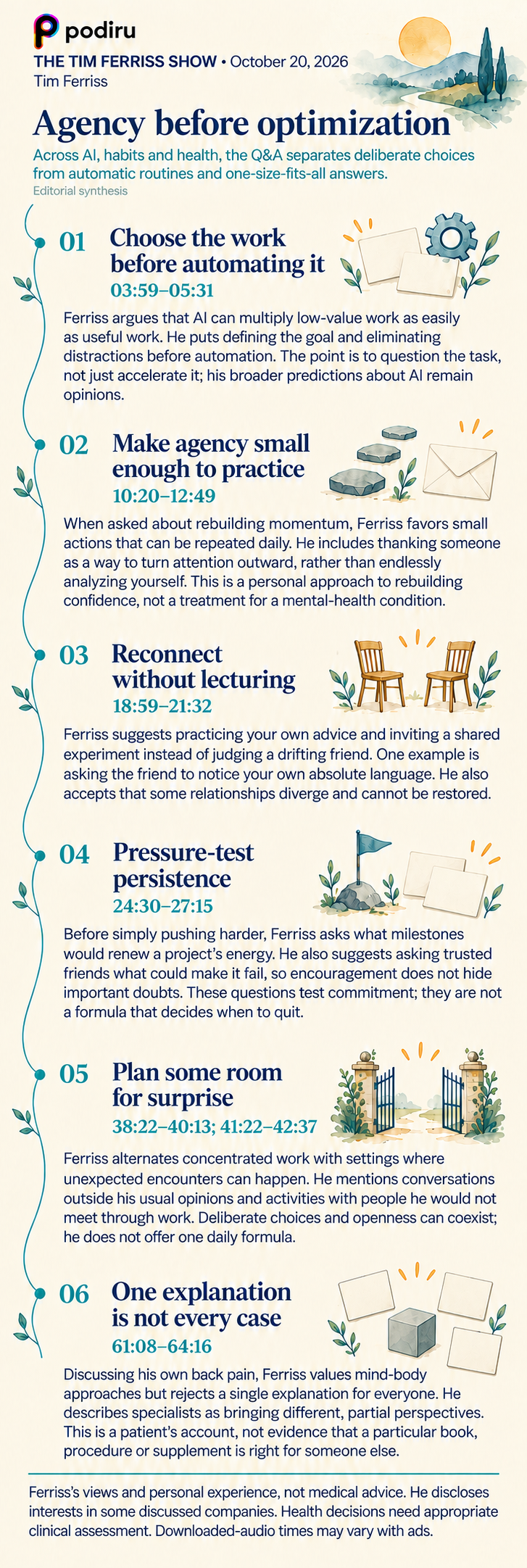
Across AI, habits and health, the Q&A separates deliberate choices from automatic routines and one-size-fits-all answers.
- 01
Choose the work before automating it
Ferriss argues that AI can multiply low-value work as easily as useful work. He puts defining the goal and eliminating distractions before automation. The point is to question the task, not just accelerate it; his broader predictions about AI remain opinions.
Why it matters · our reading A faster process is not necessarily a more worthwhile process. Selecting the goal comes before selecting the tool.
Keep in mind: This is Ferriss’s framework and forecast, not a measured estimate of AI productivity. He discloses investments in frontier AI labs.
Source passage: 03:59–05:31
- 02
Make agency small enough to practice
When asked about rebuilding momentum, Ferriss favors small actions that can be repeated daily. He includes thanking someone as a way to turn attention outward, rather than endlessly analyzing yourself. This is a personal approach to rebuilding confidence, not a treatment for a mental-health condition.
Why it matters · our reading Repeatable behavior offers a concrete alternative to waiting for a complete internal explanation or a dramatic transformation.
Keep in mind: The episode does not establish clinical effectiveness or promise that a habit resolves a person’s circumstances.
Source passage: 10:20–12:49
- 03
Reconnect without lecturing
Ferriss suggests practicing your own advice and inviting a shared experiment instead of judging a drifting friend. One example is asking the friend to notice your own absolute language. He also accepts that some relationships diverge and cannot be restored.
Why it matters · our reading Making oneself accountable changes the interaction from correcting another person to testing a practice together.
Keep in mind: This is interpersonal advice, not a claim that every relationship should be preserved or that another person can be made to change.
Source passage: 18:59–21:32
- 04
Pressure-test persistence
Before simply pushing harder, Ferriss asks what milestones would renew a project’s energy. He also suggests asking trusted friends what could make it fail, so encouragement does not hide important doubts. These questions test commitment; they are not a formula that decides when to quit.
Why it matters · our reading Separating motivating progress from credible failure modes can reveal assumptions that reassurance alone leaves unexamined.
Keep in mind: Friends’ opinions are fallible. The discussion does not establish a universal timeline, success probability or exit rule.
Source passage: 24:30–27:15
- 05
Plan some room for surprise
Ferriss alternates concentrated work with settings where unexpected encounters can happen. He mentions conversations outside his usual opinions and activities with people he would not meet through work. Deliberate choices and openness can coexist; he does not offer one daily formula.
Why it matters · our reading Choosing a setting can widen the range of encounters without pretending to control what the encounter will produce.
Keep in mind: These are examples from his own life, not a guarantee of creativity, opportunity or a better relationship.
Source passage: 38:22–40:13; 41:22–42:37
- 06
One explanation is not every case
Discussing his own back pain, Ferriss values mind-body approaches but rejects a single explanation for everyone. He describes specialists as bringing different, partial perspectives. This is a patient’s account, not evidence that a particular book, procedure or supplement is right for someone else.
Why it matters · our reading A useful perspective can still be incomplete; a personal health story should not become a universal treatment rule.
Keep in mind: Ferriss is not a clinician. The brief does not validate his diagnoses, planned treatment or product claims. Medical decisions require appropriate clinical assessment.
Source passage: 61:08–64:16
How the ideas connect
The opening separates choosing a goal from optimizing execution. The agency and friendship chapters turn that distinction into small, observable actions. The persistence chapter adds outside challenge; the serendipity chapter leaves room for what cannot be planned. The health discussion supplies a different domain in which a single framework may be incomplete. This cross-chapter connection is editorial interpretation, not a clinical or causal conclusion.
Full-episode overview
Tim Ferriss answers audience questions in the first of two Q&A installments. He revisits The 4-Hour Workweek’s definition, elimination, automation and liberation framework, arguing that choosing worthwhile work becomes more important as tools accelerate execution. He also reflects on advice written at an earlier life stage and on deciding what gives freed time meaning. The practical discussion covers small repeated actions, expressing gratitude, questions that connect reflection with action, changing friendships, and testing persistence with energizing milestones and honest failure scenarios.
The middle of the conversation turns to over-optimization, prioritizing relationships and health, and creating room for encounters outside familiar professional or political circles. Ferriss discusses his own writing environment, live Q&A format, meditation and preparation routines. His specific substance, exercise and diet practices are not reproduced as recommendations. Questions about grief and new parenthood lead to book suggestions and relationship and fitness priorities; he is not speaking from personal parenthood experience.
Several substantial sections concern health. Ferriss describes a vision-training product after disclosing an investment, discusses accelerated TMS and involvement with Ampa Health, and offers personal accounts of injuries and back pain. These are reports of what he says, not independent validation of safety, efficacy, diagnoses or treatment choices. The map retains the distinction between a useful perspective and a one-size-fits-all explanation, without endorsing a particular treatment. He also says older supplement research needs revisiting and qualifies his judgment as an opinion. Prices, offers, ingredients, doses and efficacy claims are omitted. He discloses investments in frontier AI labs, Oryx and The Way; his statement of involvement with Ampa Health is not expanded into an unsupported description of the financial relationship. All sponsor messages, promotions and the ending were reviewed but are not substantive recommendations.
Date note: the selected podcast catalog entry is dated October 20, 2026; the publisher’s episode and transcript pages are dated October 21. The title, episode number, voice, content and ending identify the same episode. The selected catalog date is used on this brief.
Sources & the fine print
Complete machine-transcript review of the downloaded publisher audio, with targeted retranscription of flagged spans. Not a claimed manual end-to-end audio listen. Interpretations and material caveats are labeled; display times round outward and may shift in differently ad-inserted copies.
- Ferriss’s views and personal experience, not medical advice. He discloses interests in some discussed companies. Health decisions need appropriate clinical assessment. Downloaded-audio times may vary with ads.
Chart-informed editorial collection using Apple Podcasts trending episode charts, retrieved October 24, 2026. Not verified annual episode-level listening totals.