

THE CENTRAL IDEA · OUR READING
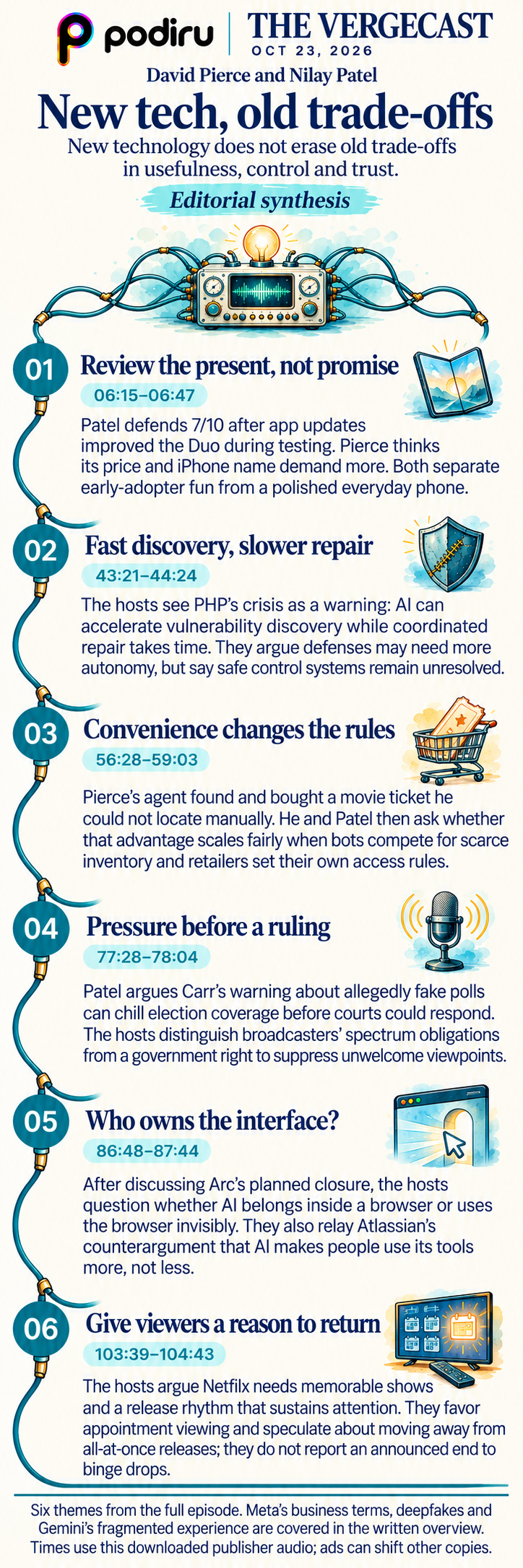
New technology does not erase old trade-offs in usefulness, control and trust.
- 01
Review the present, not promise
Patel defends 7/10 after app updates improved the Duo during testing. Pierce thinks its price and iPhone name demand more. Both separate early-adopter fun from a polished everyday phone.
Why it matters · our reading A review must judge current usefulness for its intended buyer, not give future software improvements credit in advance. Their disagreement is about that threshold, not whether experimentation is worthwhile.
Keep in mind: The score is The Verge’s subjective assessment, not a standardized performance measurement. Better apps do not guarantee fixes for size, heat or hardware compromises.
Source passage: 06:15–06:47
- 02
Fast discovery, slower repair
The hosts see PHP’s crisis as a warning: AI can accelerate vulnerability discovery while coordinated repair takes time. They argue defenses may need more autonomy, but say safe control systems remain unresolved.
Why it matters · our reading Lower discovery costs can compress the time defenders have to coordinate and deploy fixes. The PHP Foundation also describes a shortage of expert maintainers and difficult compatibility decisions.
Keep in mind: The need for autonomous defense is the hosts’ judgment, not proof that unsupervised patching is safe. The Foundation’s account is more nuanced than a single prompt independently discovering everything.
Source passage: 43:21–44:24
- 03
Convenience changes the rules
Pierce’s agent found and bought a movie ticket he could not locate manually. He and Patel then ask whether that advantage scales fairly when bots compete for scarce inventory and retailers set their own access rules.
Why it matters · our reading Automation removes friction that once limited how aggressively a shopper could search or reserve stock. Useful individual delegation can therefore create allocation and access problems at market scale.
Keep in mind: This is a personal anecdote and a hypothetical scaling problem, not proof that the ticket purchase caused an outage. Walmart’s announced controls and developer beta are not universal open access.
Source passage: 56:28–59:03
- 04
Pressure before a ruling
Patel argues Carr’s warning about allegedly fake polls can chill election coverage before courts could respond. The hosts distinguish broadcasters’ spectrum obligations from a government right to suppress unwelcome viewpoints.
Why it matters · our reading The threatened cost and uncertainty of enforcement can shape editorial decisions even without a completed case. That is the hosts’ concern about the timing of the warning.
Keep in mind: This is their legal and political assessment, not a ruling that Carr or any broadcaster broke the law. Inaccurate polling alone is not equivalent to intentional news distortion or a broadcast hoax.
Source passage: 77:28–78:04
- 05
Who owns the interface?
After discussing Arc’s planned closure, the hosts question whether AI belongs inside a browser or uses the browser invisibly. They also relay Atlassian’s counterargument that AI makes people use its tools more, not less.
Why it matters · our reading If an assistant becomes the front door, apps and browsers may lose control of the relationship with users. But supporting more AI-mediated work could also increase demand for the underlying tools.
Keep in mind: These are competing business theses, not a settled outcome. The episode’s account of Atlassian’s usage evidence is not independently audited; no browser’s disappearance is inferred from it.
Source passage: 86:48–87:44
- 06
Give viewers a reason to return
The hosts argue Netflix needs memorable shows and a release rhythm that sustains attention. They favor appointment viewing and speculate about moving away from all-at-once releases; they do not report an announced end to binge drops.
Why it matters · our reading A recurring viewing habit can make a subscription feel valuable for longer than a short burst of consumption. Their critique concerns cultural relevance and retention, not simply adding more content categories.
Keep in mind: This is their strategy argument, not proof that release schedules caused Netflix’s results. Netflix’s shareholder letter says engagement remains healthy while acknowledging concerns about view-hours growth.
Source passage: 103:39–104:43
How the ideas connect
Both discussions distinguish technical possibility from an operationally dependable system; editorial comparison, not causation. Automation changes scale in both security and ordinary shopping, though the risks and permissions differ. Retailer access rules and assistant-led interfaces both determine who controls the customer relationship. The speech section offers a separate governance question: power over an infrastructure layer does not settle every permissible use. The browser and Netflix discussions contrast control of distribution with giving people a reason to return.
Full-episode overview
David Pierce and Nilay Patel begin with their disagreement over The Verge’s iPhone Duo score. Patel says app updates during the review improved the actual product enough to justify 7/10; Pierce thinks an expensive device sold as an iPhone should meet a higher everyday-use standard. Both enjoy the experimentation but discuss the small cover screen, uneven app layouts, heat, battery and camera compromises. Their iPad comparison is a product-design argument, not a claim that the Duo runs the iPad app ecosystem. They also discuss the limits of switching a phone line between devices and separate present functionality from future hopes.
The PHP discussion treats AI-assisted vulnerability discovery as a change in the speed and economics of security work. The hosts recount disclosure and patching disputes, then debate whether defensive systems will need greater autonomy. Their broad security forecast is not proof of a universal exploit or a recommendation to grant agents unrestricted access. The PHP Foundation’s primary account confirms critical flaws and patches while describing human expertise, compatibility trade-offs and organizational constraints.
Shopping agents supply a different kind of disruption. Reported repeated cart holds and Pierce’s successful movie-ticket purchase raise questions about scarce inventory, fairness, retailer blocking and negotiated access. Their conclusions about market-wide bot competition are extrapolations from examples. They also discuss reported Muse engagement figures, unsolicited notifications, synthetic celebrity videos and a possible tension between Meta’s AI ambitions and Instagram’s existing advertising business. The brief omits unverified adoption statistics and does not convert their broad comments about likeness protections into legal advice.
In the FCC segment, the hosts criticize Brendan Carr’s warning about allegedly fake and suppression polls. Patel’s argument centers on chilling effects before an election and the difference between broadcast licensing and government viewpoint control. The episode includes Anna Gomez’s opposing position. Neither the warning nor the hosts’ reaction establishes a completed enforcement finding, a revoked license or an automatic violation by a broadcaster.
The lightning round considers Arc’s announced shutdown and whether assistants will turn browsers into background infrastructure. Patel also relays Mike Cannon-Brookes’s counterclaim that AI increases use of Atlassian’s products. A separate Meta-business-terms discussion contrasts broad contractual wording, a revision, company assurances and continuing criticism; the hosts’ interpretation is not an adjudication or a fresh independent legal review. On Netflix, they favor stronger shows and sustained viewing habits, including weekly releases, while treating a strategy change as a prediction. Netflix’s own shareholder letter describes engagement as healthy but acknowledges investor concern about view-hours growth. Finally, Patel describes inconsistent Gemini capabilities across phone, home and car, and the hosts discuss Google’s explanation of personal-intelligence permissions. Sponsor messages, comedy, other-show promotion, awards and credits were also reviewed.
Sources & the fine print
Complete machine-transcript review of the downloaded publisher audio, with targeted retranscription of flagged spans. Not a claimed manual end-to-end audio listen. Interpretations and material caveats are labeled; display times round outward and may shift in differently ad-inserted copies.
Six themes from the full episode. Meta’s business terms, deepfakes and Gemini’s fragmented experience are covered in the written overview. Times use this downloaded publisher audio; ads can shift other copies. This brief uses complete machine-transcript review, not a claimed manual end-to-end listen.
- Publisher episode and full downloaded audio
- Publisher feed
- The Verge’s Duo review, for rating and reviewed experience
- PHP Foundation release and disclosure account
- Walmart announcement, including launch limits and permissions
- Congressional Research Service explanation of news-distortion policy, Dec 10, 2025
- Official broadcast-hoax rule
- Former FCC officials’ attributed response, not a court decision
- Netflix Q3 2026 shareholder letter
- Six themes from the full episode. Meta’s business terms, deepfakes and Gemini’s fragmented experience are covered in the written overview. Times use this downloaded publisher audio; ads can shift other copies.
Chart-informed editorial collection using Apple Podcasts trending episode charts, retrieved October 24, 2026. Not verified annual episode-level listening totals.