

THE CENTRAL IDEA · OUR READING
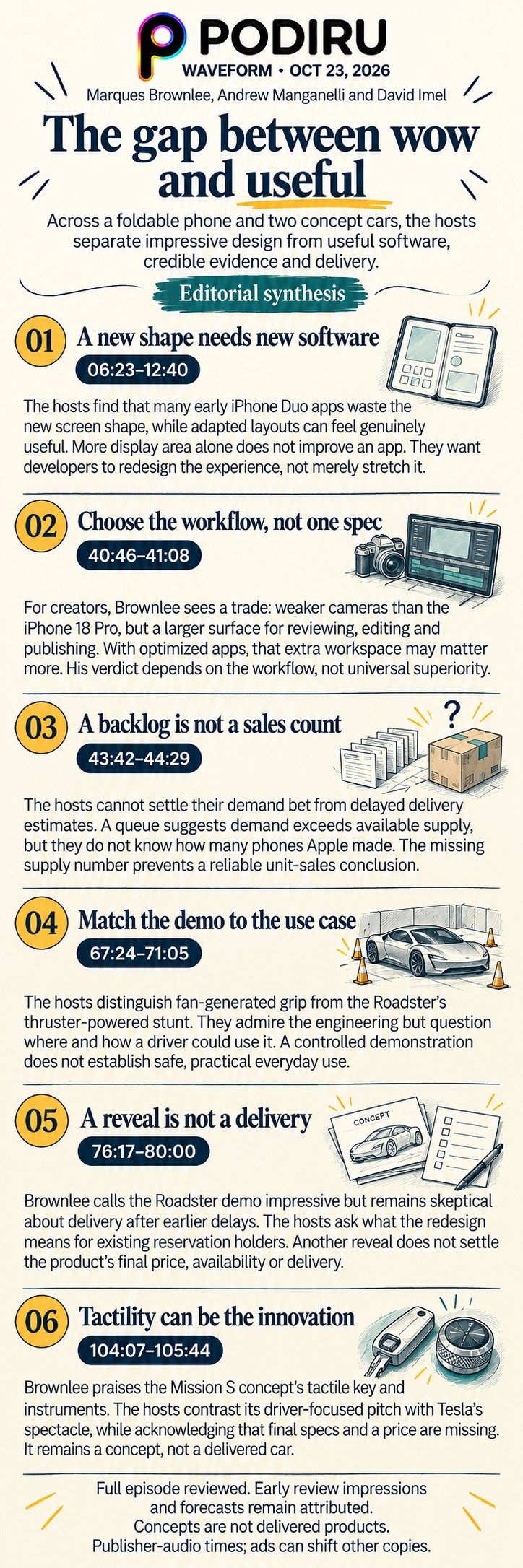
Across a foldable phone and two concept cars, the hosts separate impressive design from useful software, credible evidence and delivery.
- 01
A new shape needs new software
The hosts find that many early iPhone Duo apps waste the new screen shape, while adapted layouts can feel genuinely useful. More display area alone does not improve an app. They want developers to redesign the experience, not merely stretch it.
Why it matters · our reading The benefit of a new form factor depends on software layout and interaction design as well as hardware.
Keep in mind: These are early review observations, not a permanent compatibility verdict. Later app updates can change the experience; the hosts even retract a claim that every Apple app is already optimized.
Source passage: 06:23–12:40
- 02
Choose the workflow, not one spec
For creators, Brownlee sees a trade: weaker cameras than the iPhone 18 Pro, but a larger surface for reviewing, editing and publishing. With optimized apps, that extra workspace may matter more. His verdict depends on the workflow, not universal superiority.
Why it matters · our reading A device can lose on capture quality yet help with the rest of the creative process. The relevant comparison is the whole job the owner needs to do.
Keep in mind: Camera quality is the hosts’ comparative assessment, not a new benchmark performed for this brief. Better editing depends on app support; it does not erase handling or camera compromises.
Source passage: 40:46–41:08
- 03
A backlog is not a sales count
The hosts cannot settle their demand bet from delayed delivery estimates. A queue suggests demand exceeds available supply, but they do not know how many phones Apple made. The missing supply number prevents a reliable unit-sales conclusion.
Why it matters · our reading An observed shortage is a relationship between supply and demand, not a measurement of either one by itself.
Keep in mind: Their delivery examples are anecdotes from recording time, not a current stock check. No unit-sales total or forecast is inferred.
Source passage: 43:42–44:29
- 04
Match the demo to the use case
The hosts distinguish fan-generated grip from the Roadster’s thruster-powered stunt. They admire the engineering but question where and how a driver could use it. A controlled demonstration does not establish safe, practical everyday use.
Why it matters · our reading A spectacular capability and a useful, repeatable product feature are different tests. The episode asks about operating conditions, not just whether a stunt is impressive.
Keep in mind: This is discussion of demonstrations, not a safety certification or a universal legal ruling. The brief does not treat a stunt as permission to use a car that way on public roads.
Source passage: 67:24–71:05
- 05
A reveal is not a delivery
Brownlee calls the Roadster demo impressive but remains skeptical about delivery after earlier delays. The hosts ask what the redesign means for existing reservation holders. Another reveal does not settle the product’s final price, availability or delivery.
Why it matters · our reading Demonstrating an idea, accepting reservations and delivering a finished vehicle are separate milestones. Confidence in one does not establish the others.
Keep in mind: Skepticism is a forecast, not proof the vehicle will never ship. Current contract language, refund rights, final pricing and individual reservation outcomes are not independently adjudicated here.
Source passage: 76:17–80:00
- 06
Tactility can be the innovation
Brownlee praises the Mission S concept’s tactile key and instruments. The hosts contrast its driver-focused pitch with Tesla’s spectacle, while acknowledging that final specs and a price are missing. It remains a concept, not a delivered car.
Why it matters · our reading The conversation offers another definition of progress: improving the physical experience of using a product, rather than adding the most dramatic new capability.
Keep in mind: Taste and expectations about Porsche are the hosts’ judgments. The manufacturer describes a digital instrument design with an analogue needle, not an entirely screen-free dashboard. No production guarantee is inferred.
Source passage: 104:07–105:44
How the ideas connect
Across a foldable phone and two concept cars, the hosts separate impressive design from useful software, credible evidence and delivery.
Full-episode overview
Marques Brownlee, Andrew Manganelli and David Imel begin with notification-bug anecdotes before discussing roughly a week and a half with the iPhone Duo. Their central phone discussion is not simply whether folding is impressive. It is whether apps, handling and daily routines make effective use of the unfamiliar shape. Some apps leave wasted space, while adapted interfaces make reading, messaging and working across two apps more useful. They explicitly correct an earlier assumption that every Apple app is fully optimized.
The hosts differ about what the folding action encourages. One sees opening and closing the device as a more intentional task boundary; another stresses its multitasking potential, and the conversation jokes about using multiple feeds at once. Neither observation establishes a wellbeing benefit. Battery impressions differ, and the mix of inner-screen and outer-screen use is still evolving. The discussion also covers awkward notification targets, button placement, slippery handling, Touch ID habits and the hope for better accessories. These are early personal experiences, not universal measurements.
Camera discussion separates the inner FaceTime camera, ordinary still photos, rear-camera selfies and the physical difficulty of holding the device. Brownlee considers its cameras worse than the iPhone 18 Pro’s, yet sees advantages in a large screen for reviewing, editing and publishing when apps support it. A creator’s preferred phone therefore depends on the full workflow. The hosts also speculate about why Apple makes switching between two iPhones easier; their joking account of an internal sales strategy is not established company intent.
Delayed delivery estimates do not resolve the hosts’ earlier demand bet. They say they can see demand running ahead of available supply but do not know the production quantity. This is a useful limit on what a backlog can prove, not a unit-sales estimate. They remain interested in future foldable generations, without knowing whether a particular future model will exist. The next section speculates about an upcoming Apple event, possible touchscreen OLED laptops, hinges, stylus support, product names and iPad mini positioning. Those predictions are not presented as announced products or verified future specifications.
The Roadster section starts with the hosts explaining that the reveal occurred after the prior episode was recorded. They describe a striking redesigned car and distinguish fan-generated downforce from cold-gas-thruster demonstrations. Brownlee compares the fan mechanism with McMurtry’s Spéirling. McMurtry’s own account corroborates its earlier controlled upside-down demonstration; it does not independently verify Tesla’s performance. The hosts discuss noise, operating conditions, restrictions, occupants and possible autonomous stunt modes. Exact speeds, pressures, capacities, battery specifications and proposed configurations are omitted here rather than presented as independently measured facts.
Their admiration for the demonstration coexists with skepticism about a finished product. They raise unanswered questions about old reservations, changed designs, variants, timing and final pricing. Brownlee interprets the event as a brand-building showcase aimed at a much wider audience than potential buyers. Others challenge aspects of that comparison and the quality of the presentation. These remain interpretations, not evidence of corporate intent, fraud or market manipulation. The hosts’ prediction about Cybercab availability is likewise a forecast, not a finding about delivery.
Porsche’s Mission S provides a contrasting concept presentation. Brownlee likes its heritage references and tactile elements, particularly the key and instruments. The hosts acknowledge missing final specifications and pricing while debating how much confidence to place in a manufacturer’s record. The inspected Porsche page supports the mid-engine, driver-focused design and tactile controls, but supplies no basis for a delivery guarantee. Its instrument description also includes digital elements, so this brief does not call the cabin entirely analogue or screen-free.
The closing section includes brief TV-interface experimentation, an inadequately developed certificate-security anecdote, Google-app update trivia, the former Google Duo’s Knock Knock feature and a short PHP-related trivia question. The security asides are not treated as validated technical guidance or evidence of particular victims. Sponsors, personal jokes and promotions are excluded from the map’s takeaways. The six branches are an editorial synthesis across the complete episode, not six claims that every speaker equally endorsed.
Sources & the fine print
Complete machine-transcript review of the downloaded publisher audio, with targeted retranscription of flagged spans. Not a claimed manual end-to-end audio listen. Interpretations and material caveats are labeled; display times round outward and may shift in differently ad-inserted copies.
Selected from a current Apple US chart snapshot, not verified annual listening totals. Catalog date: October 23, 2026. Exact recording day unverified. Times refer to the downloaded publisher file and may differ in other dynamically ad-inserted copies.
- feeds.megaphone.fm
Publisher episode identity, October 23 catalog date, show description and related review links. Full downloaded publisher audio, not show notes, supplies the editorial evidence.
- www.apple.com
September 9 manufacturer announcement confirms iPhone Duo name, folding displays, Split View, side-button Touch ID and camera configurations. These are manufacturer statements, not independent validation of the hosts’ review judgments. Apple’s general app-optimization language does not override their specific observations.
- www.porsche.com
Manufacturer presentation confirms Mission S name, mid-engine concept, tactile key and controls, and an analogue needle within a digital instrument design. The inspected page does not establish a final price, release date or customer delivery.
- mcmurtry.com
April 11, 2025 manufacturer account corroborates the McMurtry Spéirling name and fan-generated downforce demonstration on a specially built rotating rig. Not independent testing or evidence of Tesla’s performance.
- www.tesla.com
Web extraction returned only trim footnotes; direct retrieval returned HTTP 403. Full specifications and current reservation terms were not independently inspected. The brief retains episode claims as attributed judgments and omits exact performance, deposit and legal-clause claims.
- youtu.be
Publisher-linked related MKBHD Roadster review. Retrieval failed; no claim to have watched this separate video.
- youtu.be
Publisher-linked related iPhone Duo review; not independently watched. The reviewed podcast itself supplies the hosts’ judgments.
- Full episode reviewed. Early review impressions and forecasts remain attributed. Concepts are not delivered products. Publisher-audio times; ads can shift other copies.
Chart-informed editorial collection using Apple Podcasts trending episode charts, retrieved October 24, 2026. Not verified annual episode-level listening totals.